

Acoustic communication is central to how elephants stay connected. They use sound to care for one another, to socialize, to coordinate movement, to find reproductive partners and respond to threats or changing situations.
Their calls — ranging from deep rumbles with infrasonic components to higher-frequency trumpets, snorts, cries and roars — carry rich information about identity, age, sex, context and emotional state. Supported by specialized anatomy and sensitivity to low-frequency sound, elephants are able to communicate effectively over long distances.

Acoustic communication allows elephants to exchange information through sound across both short and long distances. Because sound travels in all directions, vocalizations can reach a wide audience of intended and unintended listeners, including individuals who are out of sight or separated by considerable distances. Sounds are also short-lived and can be produced deliberately, making them well suited for conveying information about immediate events or rapidly changing situations.
For acoustic communication to be effective, elephants must both produce and detect sounds. As sound travels through the environment it is altered by reflection, refraction, and absorption. These processes tend to degrade high-frequency sounds more rapidly than low-frequency sounds. Elephants are specialists in producing and detecting very low-frequency vocalizations, which allows them to communicate effectively across large distances in open landscapes.
Our discovery in the 1980s that African elephants produce powerful infrasonic calls — sounds that are partially below the range of human hearing — revealed that elephant communication operates over spatial scales far greater than previously suspected.
African elephants produce a wide range of vocalizations, from extremely low-frequency Rumbles to higher-frequency Snorts, Roars, Cries, Husky-Cries and Trumpets, as well as a variety of unusual or idiosyncratic sounds. Laryngeal calls are produced by sound passing over the larynx, while trunk-calls are made by blowing air through the trunk. The most frequently used vocalization is the Rumble, a low-frequency call that forms the backbone of elephant acoustic communication.
Different contexts are associated with variations of these basic call types. For instance trumpets emitted during play are different from those produced at a threat or during high social arousal. Likewise rumbles produced by musth males, during matings, greetings, coordination of movement or when individuals are separated from companions differ structurally. Higher-frequency calls such as roars, cries, snorts and trumpets often occur in high arousal such as distress, social excitement, aggression, or play.
Elephants are also capable of combining different vocal elements into combination calls, such as Rumble-Roar-Rumble or Snort-Trumpet sequences. These combinations increase the complexity of the signal and may convey more detailed information about the caller’s motivational state.
In addition to typical vocalizations elephants occasionally produce idiosyncratic or imitated sounds, demonstrating a degree of vocal flexibility unusual among terrestrial mammals.
Click the links to The Elephant Ethogram to learn more about the contexts in which different calls are given by elephants and to listen to examples.
You can explore many of the vocalizations that elephants make on The Elephant Ethogram: A Library of African Elephant Behavior. The Ethogram includes more than 2,300 annotated video clips, many of which illustrate vocal communication.
Use the Filter and select “Acoustic–Vocal” under Communication Mode to find Behaviors involving sound. You can also browse by call type, including laryngeal calls (Rumbles, Roars, Cries, Barks), trunk calls (Snorts and Trumpets), combination calls (e.g., Rumble-Roar-Rumble), and imitated or idiosyncratic sounds.
Click on individual Behaviors such as Musth-Rumble, Let’s-Go-Rumble, Nasal-Trumpet, Pulsated-Trumpet, or Truck-Like-Call to learn more about how elephants communicate.
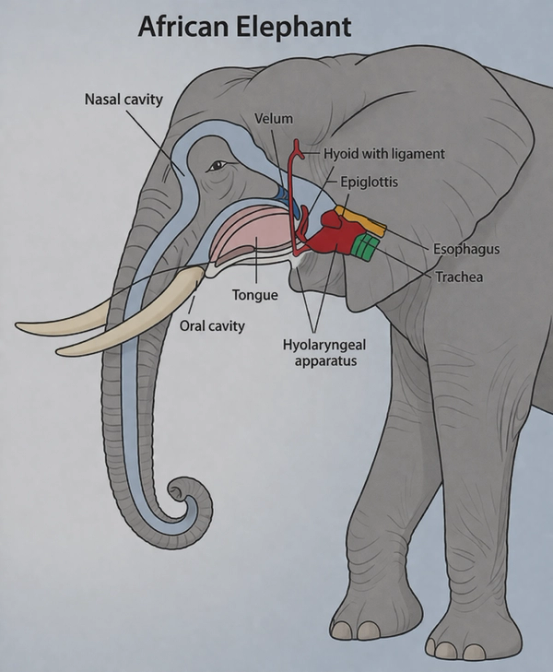
Vocal apparatus of an African elephant. Calls produced in the larynx are filtered through the oral and nasal cavities. (Diagram after Herbst et al 2012)
As in other mammals, elephant vocalizations are produced when air expelled from the lungs passes through the larynx, a structure some 7.5 cm long, causing the vocal folds to vibrate. The rate of this vibration determines the fundamental frequency, or basic pitch, of the sound produced.
Elephants possess several anatomical features that allow them to produce exceptionally low-frequency, powerful and variable vocalizations.
First, their large body size contributes to low-frequency sound production. In general, larger animals produce lower-frequency calls because they have longer and more massive vocal folds, which vibrate more slowly.
Second, elephants possess an unusually flexible hyoid apparatus, the system of bones and connective tissues that supports the tongue and suspends the larynx. Unlike most mammals, in which the hyoid is rigidly connected to the skull, the elephant’s hyoid is attached by muscles, ligaments, and tendons. This loose suspension allows greater mobility of the larynx and may help elephants adjust the position and tension of the vocal folds, facilitating the production and modulation of very low-frequency calls.
Third, elephants possess a distinctive anatomical structure known as the pharyngeal pouch, located at the base of the tongue. This pouch can hold several liters of water and contributes to the overall structure of the vocal tract and its presence may influence the shape of the vocal tract during sound production.
The fundamental frequency is the lowest frequency produced by the vibration of the vocal folds in the larynx and determines the basic pitch of a call. This vibration also generates a series of higher frequencies called harmonics, which occur at multiples of the fundamental frequency.
As the sound travels through the vocal tract — the mouth, throat, pharyngeal pouch, the air-filled cavities in the frontal and maxillary bones of the elephant’s head (called pneumatized sinuses) and its trunk — these harmonics are filtered and shaped, producing resonant frequency bands known as formants, which help give each call its characteristic sound.
- Source: vibration of the vocal folds → creates the fundamental frequency and harmonics
- Filter: the vocal tract (mouth, throat, trunk) → shapes the sound and creates formants
Elephant vocalizations span an exceptionally wide range of frequencies. For comparison, the fundamental frequency of a typical human male speaking voice averages around 110 Hz, while female voices average about 220 Hz.
The fundamental frequency of an adult elephant rumble typically lies between 12 and 20 Hz, more than three octaves below the average male human voice and below the lower limit of human hearing. Calves often produce rumbles at higher fundamental frequencies, (~20-35 Hz) reflecting their smaller body size and shorter vocal folds.
Elephants can also show remarkable flexibility within a single vocalization. While the pitch of normal human speech usually varies over about one octave, and even trained singers rarely exceed two octaves, the fundamental frequency of a single elephant combination call can span up to over four octaves — for example beginning as a low-frequency Rumble around 20 Hz and grading into a Roar approaching 470 Hz.
Elephants can produce very soft rumbles that are barely above background noise as well as extremely powerful ones. Some vocalizations have been measured at over 110 decibels at one meter from the source. Because the decibel scale is logarithmic, these calls are extraordinarily loud — comparable to the sound levels produced by loud machinery or amplified music.
Listen to an examples of a barely audible rumbles and a very powerful rumbles (headphones recommended).
Decibels are measured on a logarithmic scale. To give you some idea of how loud some elephant sounds are we have included information from a table in The Science of Sound by T.D. Rossing, which gives some examples of typical sound levels you might encounter.

The low frequencies used in elephant rumbles are particularly well suited for long-distance communication. Lower-frequency sounds travel farther than higher-frequency sounds because they experience less absorption and scattering in the environment.
Sound traveling through air attenuates according to the inverse square law, losing approximately 6 decibels (dB) each time the distance from the source doubles. Environmental factors such as vegetation, wind, terrain, and atmospheric conditions can further affect how sound travels through the landscape.
Because elephant rumbles contain strong low-frequency components, they can travel considerable distances with relatively little degradation. Some elephant calls are extremely powerful and may reach sound levels of about 112 decibels (dB) measured one meter from the source.
During typical daytime conditions, powerful elephant rumbles may be detected at distances of roughly 2–4 km, corresponding to a calling area of approximately 10–50 km². However, the distance over which elephants can recognize the identity of the caller is shorter. Playback experiments have shown that elephants can recognize the voices of particular individuals at distances of about 1–1.5 km, and occasionally up to 2.5 km.
Under favorable atmospheric conditions, particularly during evening temperature inversions when sound transmission improves, the detection distance may increase to 7–10 km, expanding the potential calling area to 150–300 km², although individual recognition is likely limited to much shorter distances.
Powerful rumbles also contain a rich harmonic structure, which may help listening elephants estimate how far away the caller is. As sound travels through the environment, higher frequencies gradually weaken while the lowest frequencies persist. By detecting these changes in the harmonic structure, elephants may gain information about the distance of the calling individual.
When elephants produce powerful rumbles, a portion of the acoustic energy also enters the ground, creating seismic waves that propagate through the substrate. These ground-borne vibrations can travel considerable distances and may be detected by other elephants through vibration-sensitive receptors in their feet and trunk.
In this way, a single rumble may function simultaneously as both an acoustic signal traveling through the air and a seismic signal traveling through the ground, allowing elephants to communicate across large landscapes using multiple sensory channels.
Because elephant rumbles generate both airborne sound and ground-borne vibrations, their communication system spans more than one sensory pathway. To learn more about how elephants detect these vibrations through their feet and trunk, see our section on Tactile Communication and Seismic Signalling.


Another distinctive feature of the elephant ear lies in the structure of the cochlea, the spiral organ of the inner ear responsible for converting mechanical vibrations into neural signals.
Elephants, together with their closest living relatives the Sirenia (manatees and dugongs), possess a cochlear structure that resembles that of reptiles more closely than that of most modern mammals. This structure may enhance sensitivity to low-frequency vibrations.
Because reptiles are particularly sensitive to substrate vibrations, some researchers have suggested that this cochlear configuration may also contribute to elephants’ ability to detect vibrational signals, including those transmitted through the ground.
Only one detailed experimental study has measured the hearing sensitivity of an elephant directly. In this study, a captive juvenile female Asian elephant was tested using behavioral audiometry. She was able to detect airborne sounds as low as 16 Hz at 65 dB, demonstrating clear sensitivity within the infrasonic range.
Because the test stimuli were not extended below this frequency, the true lower limit of elephant hearing remains unknown. However, field recordings show that elephant rumbles may have fundamental frequencies as low as 8 Hz, and some researchers have reported calls approaching 5 Hz. It is therefore likely that elephants can detect sounds even lower than those measured in the original lab study.
Elephants may also perceive extremely low frequencies through vibration detection, rather than through airborne hearing alone. Research by Caitlin O’Connell-Rodwell and colleagues have demonstrated that elephant rumbles generate seismic vibrations that travel through the ground and can be detected through vibration-sensitive receptors in the feet and trunk. These two sensory channels — airborne hearing and vibration detection — may work together to extend elephants’ perception of low-frequency signals.
Elephants are highly skilled at localizing the source of sounds. The large distance between their ears — the interaural distance — provides strong cues for sound localization. Differences in the time of arrival and intensity of sound reaching each ear allow elephants to determine the direction of a sound source.
Elephants enhance these cues by extending their ears outward when listening to effectively increasing the spacing between the ears and improving directional sensitivity.
In experimental tests, a juvenile Asian elephant was able to localize clicks and noise bursts to within 1 degree of accuracy. She was somewhat less accurate with pure tones but could still localize low-frequency tones remarkably well. For frequencies below about 300 Hz, she localized sounds within 10 degrees about 75% of the time, within 20 degrees about 80% of the time, and within 30 degrees about 90% of the time.
Field observations confirm these abilities. During playback experiments of Musth-Rumbles, males in musth were able to detect and orient toward the sound source (a six second long recording played from a loudspeaker in our jeep) from distances of over 100 meters, often walking directly toward the speaker and stopping next to our vehicle, as if he expected the rival calling male to be there.
Although this section focuses on sound, elephant communication rarely relies on a single sensory channel. Vocalizations are often accompanied by visual displays, tactile contact and chemical cues, creating a rich multimodal communication system in which information is transmitted simultaneously through multiple senses. The meaning of a call is therefore shaped not only by the sound itself, but also by the posture, movements, odors, and tactile interactions that occur alongside it.
Check out some good examples of acoustic communication in a multimodal system in the 2014 National Geographic article about our work, "What Elephant Calls Mean: A User's Guide".

Berg JK. 1983. Vocalizations and associated behaviours of the African elephant Loxodonta africana in captivity. Z Tierpsychol. 63:63–79. https://doi.org/10.1111/j.1439-0310.1983.tb00741.x
Dneprovskaya IA, Iofe VK, Levitas FI. 1963. On the attenuation of sound as it propagates through the atmosphere. Sov Phys Acoust. 8:235–239.
Fischer MS. 1990. The unique ear of elephants and manatees (Mammalia): a phylogenetic paradox. C R Acad Sci Ser III Sci Vie. 331:157–162.


The largest video and audio library of elephant behaviors.