
- written by Petter
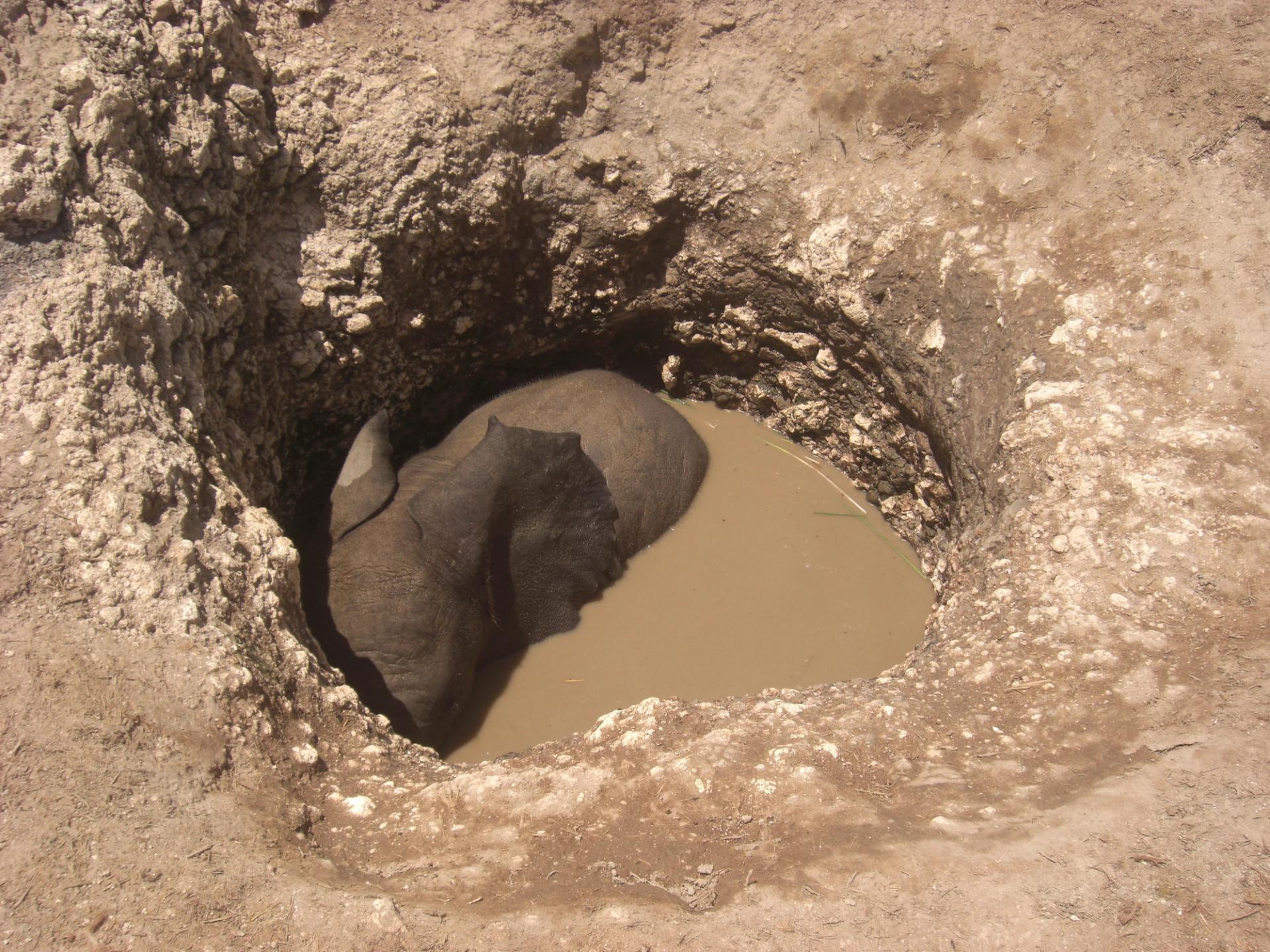
February 6th 2009 began like any other morning in the field. I had been out recording with our then field assistant, Blake Murray, for several hours when we received word from Amboseli Trust for Elephants (ATE) research assistant Katito Sayialel that a baby elephant had been reported stuck in a well west of Amboseli National Park. We immediately decided to go and investigate together.
Communication with the Maasai who had contacted ATE was patchy because of poor cellphone coverage, but it didn’t take long before we located the site just a few meters from the Tanzanian border. Maasai herders, along with their cows and donkeys, were gathered nearby. They told us the calf had been trapped in the well and struggling since the previous night.
The well was approximately 1.2 meters deep and for a calf less than a year old and weighing roughly 160 kilograms (350 pounds), it was an inescapable trap. Each attempt to climb out only led to further exhaustion.
Rescuing a 350-pound elephant calf from a well is no simple task. The immediate technical challenge is extraction. The equally serious biological and behavioral consideration is the calf’s family. When calves vocalize in distress, their calls can carry over long distances and may trigger defensive responses from nearby relatives. Katito suggested we first try to locate the family to assess whether a reunion after rescue would be possible. She also contacted the Kenya Wildlife Service for advice and assistance. Unfortunately, they were unable to come, and we realized we would have to handle the situation ourselves.
While searching for the family, Blakes who’s assignment during his ten-week field stay with ElephantVoices was to record rare calls,attempted to capture the calf’s low, mournful cries on our Nagra digital recorder - heartbreaking sounds of exhaustion and distress.
Despite extensive searching, we were unable to locate the family, and increasingly concerned that the calf might seriously injure himself in repeated attempts to escape, we knew we had to act. Katito contacted the Sheldrick Wildlife Trust in Nairobi, and they were prepared to fly in and collect the calf. With the help of our Maasai friends, we carefully lifted the calf out using ropes placed gently around his belly.
The next challenge was loading him into the back of our well-worn Land Cruiser — its first ever elephant passenger. Fortunately, we had a foam pad (normally used to stabilize camera equipment) that served perfectly as a headrest. Exhausted from his ordeal, the calf quickly fell asleep once he was safely inside the vehicle.
At the airstrip, the Sheldrick keepers already waiting and were quickly able to feed him some milk before preparing him for the flight back to Nairobi. Despite the trauma of separation and entrapment, he appeared physically strong, well-nourished, and remarkably calm. Within an hour, he was airborne en route to Nairobi and the Sheldrick orphanage, accompanied by an experienced Sheldrick team.
Of course, it is never good news when a baby elephant becomes separated from their family. Elephant calves are deeply dependent on their mothers and extended family for nutrition, protection, and social learning. Yet under the circumstances, we believe this was the best possible outcome. For Blake and I, the day turned out very differently than expected. We crossed our fingers for the little calf from the well.
On February 28th, 2010, we visited him at the Sheldrick orphanage in Nairobi. He had been named Kibo, after the highest peak of Mount Kilimanjaro (5,895 meters). The name felt fitting. Kibo was healthy, playful, and thriving.
In 2011, he graduated to the Ithumba Reintegration Unit, where orphaned elephants transition toward independent life in a semi-wild setting. There, they learn ecological skills, social negotiation, and foraging strategies alongside other rescued elephants. Reintegration is a gradual process, designed to allow former orphans to reclaim a wild existence.
Today, Kibo is 17 years old and living freely in Tsavo National Park, part of a population that includes many elephants rescued and rehabilitated by the Sheldrick Trust. Though independent, he continues to visit the Ithumba stockades - an enduring example of the long-term social bonds that define elephant society.
We are grateful to have played a part in Kibo’s rescue.
You can adopt Kibo and read more about his life here.

When Elephants Mourn
There are many stories about how elephants respond to death. In her years among them, Joyce has witnessed much that has moved her — but it is Tonie’s heartbreaking vigil that has remained with her, lingering longer than all the rest.
Ella's Easter Baby
What occasion could be more important than welcoming a new member of the team? Joyce recalls the very special moment she watched Ella give birth.
An Elephant Never Forgets
On impulse, I slowly reached out and touched the end of his tusk, acutely aware of the risk. Vladimir could easily have done some damage had he chosen to do so. Instead, he responded with remarkable calm.
The largest video and audio library of elephant behaviors.