
This section offers more detail about The Elephant Ethogram for scientists and those who are interested in learning more about how the work was accomplished. It includes an abstract, introduction, methods, selected results with discussion, and references. A scientific paper on The Elephant Ethogram was published in Pachyderm on 30 October 2021.
The Elephant Ethogram: A Library of African Elephant Behavior (TEE) is an ElephantVoices initiative to document the complex and diverse repertoire of African savanna elephant (Loxodonta africana) behavior and communication. In a unique, user-friendly and fully searchable online database, TEE documents the rich postural, gestural, tactile, chemical and acoustic communication and behavior of savanna elephants, including rare, novel and idiosyncratic behavior, as well as that expressed in response to people. The Elephant Ethogram is based on our decades of behavioral studies and our photographic, acoustic and videographic collections from Amboseli National Park and Maasai Mara ecosystem, Kenya, and from Gorongosa National Park, Mozambique, as well as on raw video footage from documentaries filmed in the Maasai Mara and Gorongosa, and on footage of unusual behavior filmed by our colleagues and the general public.
TEE is built on ElephantVoices previous online behavior and calls databases (and see also Poole & Granli 2011 and Poole 2011), to which we have added hundreds of new behaviors, included video, and improved the structure and functionality of the database. We intend TEE to be a repository for scientific study and comparison, and to inspire broader interest in elephant behavior, conservation and welfare. We, therefore, include introductory and explanatory information suitable for both audiences. We define 322 Behaviors, 103 Behavioral Constellations and 23 Contexts. The Elephant Ethogram is a living database and we will continue to supplement it over the coming years with currently undocumented behavior and additional or unusual video clips or photographs. We welcome comments, behaviors for inclusion, or submissions of interesting video from our colleagues or members of the public. Please use the Contact Us form. The first version of TEE was made available in late April 2021.
African savanna elephants are among the most socially complex non-human species (McComb et al 2000, Poole & Moss 2008) on our planet, as well as one of the more heavily exploited. As scientists document their extraordinary behavior, elephants are increasingly impacted by humans and their lives are changing. The Elephant Ethogram is a multimedia catalogue, or library, that aims to describe the characteristics and, where possible, the functions of the behaviors that have been recorded for African savanna elephants (Loxodonta africana).
We intend TEE to be a repository for scientific study and comparison, and to inspire broader interest in elephant behavior, conservation and welfare. It replaces ElephantVoices' online Elephant Gestures and Elephant Calls Databases developed originally in 2003 and revamped in 2011 (and see Poole & Granli 2011 and Poole 2011), that were based on our decades of study in Amboseli, Kenya and the work of other scientists (e.g., Douglas-Hamilton 1972, Kahl & Armstrong 2000, 2002, Moss 1983). Unique in their detail and scope, the original databases constituted the only accessible online documentation of the repertoire of African elephant behavior. TEE combines, restructures and dramatically expands on those databases and includes many more behaviors, annotated video clips, higher-resolution images, additional audio files and examples from additional populations. We aim to create an exhaustive list of the behavior of this species.
Further to our behavior studies of elephants in Amboseli between 1975 and 2009, we carried out elephant behavior and conservation projects in Maasai Mara, Kenya and Gorongosa, Mozambique between 2011 and 2019, during which we collected images and video of the behavior of known individuals. Furthermore, in a groundbreaking collaboration with copyright owners Off the Fence (The Netherlands), Gorongosa Media Project (US/Mozambique) and Bob Poole Films, hundreds of hours of raw footage of elephant behavior, originally shot for documentaries in Gorongosa and the Mara, were granted to ElephantVoices for use in science and education. Since we worked in collaboration with the filmmakers, this footage is also of known individuals. From these two sources, as well as our own footage from Amboseli, Mara and Gorongosa, we are now able to document behaviors with video and to report behaviors not described in our original databases.
The Elephant Ethogram documents behavior observed in three primary elephant populations: Amboseli and Maasai Mara, Kenya and Gorongosa, Mozambique. We include a short contextual description of each population touching on location, habitat type, historic level of security and other factors that might affect the behavior we document in The Elephant Ethogram.
Amboseli
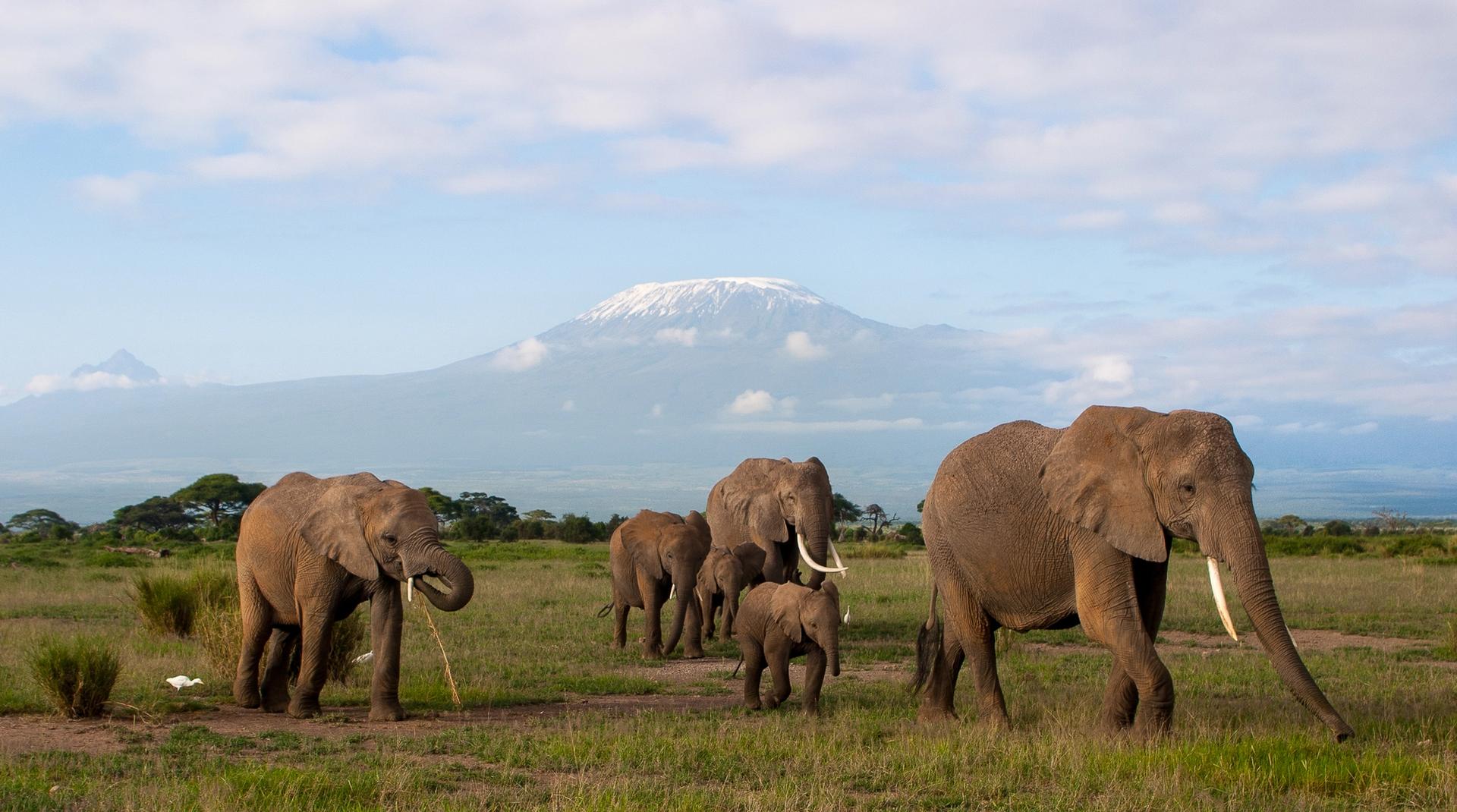
Amboseli National Park is located in Kajiado County in southern Kenya, at the northern base of Kilimanjaro. The 390 km2 national park lies within the Amboseli ecosystem, a roughly 8,000 km2 area that straddles the Kenya-Tanzania border (Western 1973, Lindsay 1982). Apart from a series of spring-fed swamps, there are no perennial rivers, and scarcity of permanent water is a salient feature of the ecosystem. Rain falls in two seasons, the short rains in November-December and the long rains in March-May, accumulating an average of 340 mm per year. The ecosystem's dominant vegetation includes open-bushed grasslands, Acacia-dominated bushland and, inside the park, swamp, swamp-edged grasslands and patches of Acacia woodlands (Pratt et al 1966). The Amboseli elephants are primarily grazers and may gather in large aggregations of several hundred elephants during seasons of abundance.
Terms used in the Filter Search
Behavior
A Behavior is a unique movement or action in response to a particular situation or stimulus. When the word Behavior(s) is capitalized we are referring to Behaviors that are defined in TEE, whereas the term without capitalization refers to generalized behavior of elephants. The structure of The Elephant Ethogram is built upon uniquely observable Behaviors (e.g. Chin-In, Ear-Wave, Trunk-Twisting). Each of 322 Behaviors is documented by a detailed written description, noting: its form; its function, if apparent; the ages and genders of those observed to engage in the behavior; the Behavioral Context(s) or "Context(s)" in which it occurs and video examples. Where relevant, we include audio examples. When the Behavior occurs in more than one Context, we note the age and sex of participants by Context. We aim to include video examples of the Behavior as it is expressed in the different Contexts.
Constellation
Elephant sightings
Over the course of 45 years we studied elephants in Amboseli (1975-1989; 1998-2009; 2020), Tsavo (1998), Maasai Mara (2011-2015) and Gorongosa (2011-2019). We collected sightings data on each group that we observed (see Definitions for explanation of "sighting"). In the early years in Amboseli (1975-1989) we carried out focal and scan sampling (Altman 1974) and from 1985-2009 and in 2020, when were were recording sound, we collected additional data (see Audio recording below). We collected ad libitum field notes to document interesting behavior.
The elephants of Amboseli have been monitored by the Amboseli Trust for Elephants (ATE) since 1972; all are individually recognized and most are of known age. Data on the life history of each elephant are held by ATE in a demography database and every observation, or sighting, of each individual is held in a sightings database, both in Microsoft Access. More information can be found in Moss et al 2011.
In Maasai Mara and Gorongosa we built four online databases to house similar information for the two populations: the Mara Elephant Who's Who and Whereabouts Databases and the Gorongosa Who's Who and Whereabouts Databases. Both databases are live, although the Gorongosa database is password protected. We photographed each individual in each group we sighted and registered new individuals in the respective Who's Who Database and entered the group sighting in the Whereabouts Database. Following protocols established in Amboseli, we registered individual elephants with an ID number, noted his or her family, putative mother, estimated birthdate (each with a code for accuracy), together with 6 photographs, and we coded in information on 8 physiognomic characteristics. We collected sightings data via a cellphone application and included: observer, date, time, location, group type, number of elephants, individual identities, individuals in musth or estrus, information on wounded elephants and field notes.
Behaviors & Behavioral Constellations
The name of each Behavior or Constellation is capitalized, and hyphenated if it contains more than one word (e.g. Ears-Stiff, Musth-Rumble, Lets-Go-Rumble). We have used simple anatomical terms (e.g. J-Trunk, Periscope-Trunk, Ear-Wave, Tail-Swat), complex anatomical terms (Coprophagia, Clamber), simple functional terms (e.g. Chase, Charge,) as well as complex functional terms (e.g. Guiding, Helping, Conciliation, Waiting) (e.g., Nishida et al 1999). There is a fair amount of inconsistency in the grammatical structure of the names, with some being verbs and some nouns. For instance, we refer to Ear-Folding and Ear-Lifting, but an Ear-Wave and Ears-Stiff. Where Behaviors and Constellations are mentioned in the descriptions and in the video annotations we adjust the names to make the sentence grammatically correct, thus, "Pascal Ear-Waves at Paolo," "Angelina Waits for her twins, Looking-Back to see whether they are coming," or "Little Male Ear-Folded at Tim."
If we were able to detect consistent differences in the appearance or form of similar Behaviors we assigned them different names (e.g. Circus-Pose, Periscope-Trunk, Trunk-Sweep, Reaching-High). Conversely, we have given the same name to all behaviors that have the same appearance. Thus, for example, Periscope-Sniff (Poole & Granli, 2011) and Distant-Frontal-Attitude (Kühme, 1972) are now combined and referred to as Periscope-Trunk. Our aim has been for all Behaviors of the same form, to have the same name, even though they may have different functions or carry different meanings in different Contexts. For example, depending on the Context, Trunk-to-Mouth may be a gesture of greeting or of reassurance, a signal to initiate a coalition or to signal victory, to solicit food, as well as, possibly, to assess physical state. Periscope-Trunk may be used to sniff a scent carried on the wind, to signal "heads-up" to others, to solicit suckling, and, in anticipatory situations, possibly to signal preparedness.
For each Behavior or Constellation defined in the database we coded in the following searchable information: 1) the Context(s) in which the behavior has been observed to occur (selected from the 23 Contexts listed on the Ethogram Table); 2) the age and sex classes of elephants that have been observed to (or assumed to) engage in the behavior (adult female, estrous female, adult male, musth male, juvenile or adolescent female, juvenile or adolescent male, calf, infant). Note that we have coded musth male and estrous female for Behaviors and Constellations that are typical of these sexually active individuals; 3) the part of the body actively used to engage in the behavior (entire body, ears, eyes, forefeet, genitals, head, hind-feet, mouth, tail, temporal glands, trunk, tusks); 4) the likely primary mode(s) of communication (acoustic-vocal, acoustic non-vocal, chemical, seismic, tactile, visual).
Most of the Behaviors and Constellations are signals, while some are just things that elephants do (Drinking, Fell-Tree, Dig-Minerals). All are associated with sounds, scents, postures, actions, movements, touches or vibrations that can convey information to other elephants. Therefore, for each Behavior or Constellation, we have indicated what modes of communication the actor/signaler(s) might be using to communicate with other elephants and/or that other elephants might be using to gain information about the actor. In some cases (e.g. acoustic-vocal for vocalizations) this is obvious, whereas in other cases (e.g., various foraging techniques) this may be conjecture.
We "mined" or "trawled through" 18TB of raw video footage, 241K photographs and 156GB of audio recordings and extracted clear examples of any behavior or behavioral patterns that we recognized from many years of observing elephants. In the process we also discovered behavior that we had not previously noted, as well as novel and idiosyncratic . Below we describe the mining and extraction process we used for videographic, photographic and audiographic material.
Video
Once Behavior/Constellation sequences were populated from available footage, we began the process of editing them for use in The Elephant Ethogram. To each selected example, we added the Behavior or Constellation name on the lower left, ElephantVoices name on the lower right, and footage credits at the end. If the Behavior/Constellation was a vocalization we added a speaker icon after the Behavior/Constellation name.
To help the viewer focus on the Behavior in question, we frequently highlighted it with a circle, as it occurred, or followed its movement with a moving circle. In some cases we followed the main clip with the specific Behavior replayed in slow motion.
In the Behavioral Constellation clips we added the individual Behavior names in italics as they occurred in the clip. Many of the clips of Behavioral Constellations involved several individuals engaged in numerous Behaviors. It was not always possible to include all of the Behaviors.
We annotated each clip with a detailed caption describing the context, the individuals involved and the specific Behaviors they engaged in. Since we studied each of these populations, we were familiar with the individual elephants in the vast majority of the video examples. We referred to known elephants by name or ID code, otherwise we noted them by age, sex and characteristics.
Video
As we prepared clips for export we entered all information (Behavior or Constellation Name, Context, Population, Filename, Caption) into a FileMaker Database. Thus, the marker name and caption on each of the prepared examples match the entry in the FileMaker Database. We exported clips in H264, 1080px, .mp4. format and stored them on ElephantVoices' server.
We uploaded prepared clips, together with their captions and the context in which the Behavior/Constellation occurred to ElephantVoices Vimeo-account and, simultaneously, linked them from there to the specific page on The Elephant Ethogram where we described the respective Behavior or Constellation. The date of upload and the Vimeo URL were entered on the same line in the FileMaker Database.
Audio
We selected a sample of elephant calls (n=~300), in .wav format, from our FileMaker Elephant Calls Database and uploaded these and related metadata (population, annotations regarding callers and behavioral context, file name) to ElephantVoices account on SoundCloud. We, consequently, linked each call from there to the page on The Elephant Ethogram where we described the respective vocalization.
The results presented below offer a summary of the collection. We present results based on two types of data: 1) the number of videos and 2) the characteristics of each Behavior coded into the database.
Comparing frequencies of Behaviors within or across populations was not an original objective of the TEE project and we acknowledge numerous biases in the data (see below). While the data indicate broad differences between populations that appear to be related to environmental opportunities and perceived threats as well as historical events, the results must be viewed with caution.
Biases in the data were introduced at various steps along the way. First, we began this work with some 40 years of experience observing elephants and had already produced two savanna elephant ethograms — one on vocal repertoire and another of non-vocal behavior. We, therefore, came to this task with well-formed ideas about elephant behavior as well as with the majority of behaviors and calls already named. While we aimed to stay open to proving previous assumptions wrong, our long experience may well have introduced biases to the data. We hope that those who use TEE can help us to correct any mistakes.
The film footage used has a number of inherent biases caused by the aims of the filmakers or the scientists, or by the responses of the elephants to them. For example, the third party Mara footage focused on the life of an infant; our fieldwork in Amboseli in 2020 aimed to capture missing reproductive behavior; Gorongosa's elephants are notoriously fearful and aggressive toward people.
Additional biases were introduced during the mining and editing processes. Joyce Poole trawled through all of the footage, and selected examples of representative behavior. Her decision to make a clip was based on three criteria. First, and foremost, was how representative it was of a particular Behavior. The second criteria was how well the photography captured the Behavior so that it could be clearly seen and understood by an inexperienced observer. The third criteria was the aesthetic quality of the photography (e.g., focus, lighting, camera jitter, unwanted background noise, etc).
Frequency of Video Examples by Context and Population
Currently (August 2021), The Elephant Ethogram holds over 2,400 video clip examples in 23 behavioral Contexts, with 813 video files from Amboseli, Kenya, 934 from the Maasai Mara, Kenya, 658 from Gorongosa, Mozambique, and three from Kruger, South Africa. While the total number of videos from the main three populations is roughly similar, examples of Behaviors and Constellations from some Contexts are disproportionately represented from the three populations. Figure 2 shows the percentage of videos across all Contexts from Amboseli, Mara and Gorongosa.
Amboseli has long been regarded as the best place in Africa to film musth males, estrous females and reproductive behavior, in general. Our specific aim in Amboseli was to document reproductive behavior as this was underrepresented in the footage from the two other populations. Behavior that falls in the Contexts of Advertizement & Attraction and Courtship makes up 30% of the Amboseli clips as compared to 5% of those from Gorongosa and the Mara. We knew, from long experience in all three populations, that we would be more likely to see and to capture reproductive behavior in Amboseli than in either of the other two populations. From a biological perspective it may seem strange for the prevalence of reproductive behavior to be so apparently dramatically different. Amboseli's open landscapes and grassland habitat is conducive to elephants forming large aggregations of individuals during and after the rains when the herb layer biomass is plentiful and when reproductive activity is concentrated (Poole & Moss, 1989). Large musth males and receptive females gravitate to these large aggregations (Poole & Moss, 1989) making reproductively active individuals easier to find, both for elephants and for the scientists hoping to study or film them. Our Amboseli filming took place following a period of historically high rainfall. We were able to observe large aggregations of individuals that included musth males and estrous females almost daily.
Correlated to the high capture of reproductive behavior in Amboseli is the greater percentage of video clips of agonistic behavior. In Amboseli 13% of videos fall in the Contexts of Aggressive and Submissive, reflecting the increased competition between males for mates that we observed and recorded, while only 7% and 4% of videos from the Mara and Gorongosa, respectively, were in these two categories.
Using the Filter Search we summarize information in The Elephant Ethogram.
The Number of Behaviors by Age/Sex Class
African elephants are known to show age and sex differences in behavior (e.g., Chiyo et al 2011a&b, Lee, 1986, Lee 1987, Lee & Moss 1999, Poole 1987, 1994, 2011, Poole & Granli 2011) as well as to express novel, idiosyncratic and socially learned behavior (e.g., Bates et al 2010, Fishlock et al 2015, Lee & Moss 1999, Poole et al 2005). An ongoing study by Bates and colleagues is examining possible cultural differences in behavior across multiple populations. While there have been hundreds of studies of African savanna elephants, and thousands of scientific papers published on wild and captive elephants, surprisingly few specifically have compared male and female behavior (but see Poole 1994) or examined developmental changes in behavior.
We will carry out a more detailed examination of sex differences and developmental acquisition of Behaviors at a later stage. Here we examine general trends. We coded in the age/sex categories of elephants that we observed or knew to engage in each Behavior (Figure 5). We acknowledge some educated guesses in the aquisition of some types of Behaviors by infants and calves. This is particularly true of the acquisition of various foraging tecniques. For examples, since tusks do not erupt until age two, infants were not coded for any Behaviors that employ tusks. We also acknowledge some educated guesses regarding the stage (calf/juvenile/adolescent) at which males transition from engaging in family Behaviors (e.g., participation in Greetings or other Bonding Behaviors) to those more represenative of adult males. In general we found that number of Behaviors employed increases with age in both sexes, but females engage in a greater variety of Behaviors than do males.
Adams J, Berg JK. 1980. Behavior of female African elephants (Loxodonta africana) in captivity. Applied Animal Ethology. 6:267–276. https://doi.org/10.1016/0304-3762(80)90027-9
Balfour D, Balfour S. 1997. African elephants: A celebration of majesty. Cape Town (South Africa): Struik Publishers. 168 p.
Bates LA, Sayialel K, Njiraini N, Moss CJ, Poole JH, Byrne RW. 2007. Elephants classify human ethnic groups by odor and garment color. Current Biology. 17:1938–1942. https://doi.org/10.1016/j.cub.2007.09.060
The largest video and audio library of elephant behaviors.