
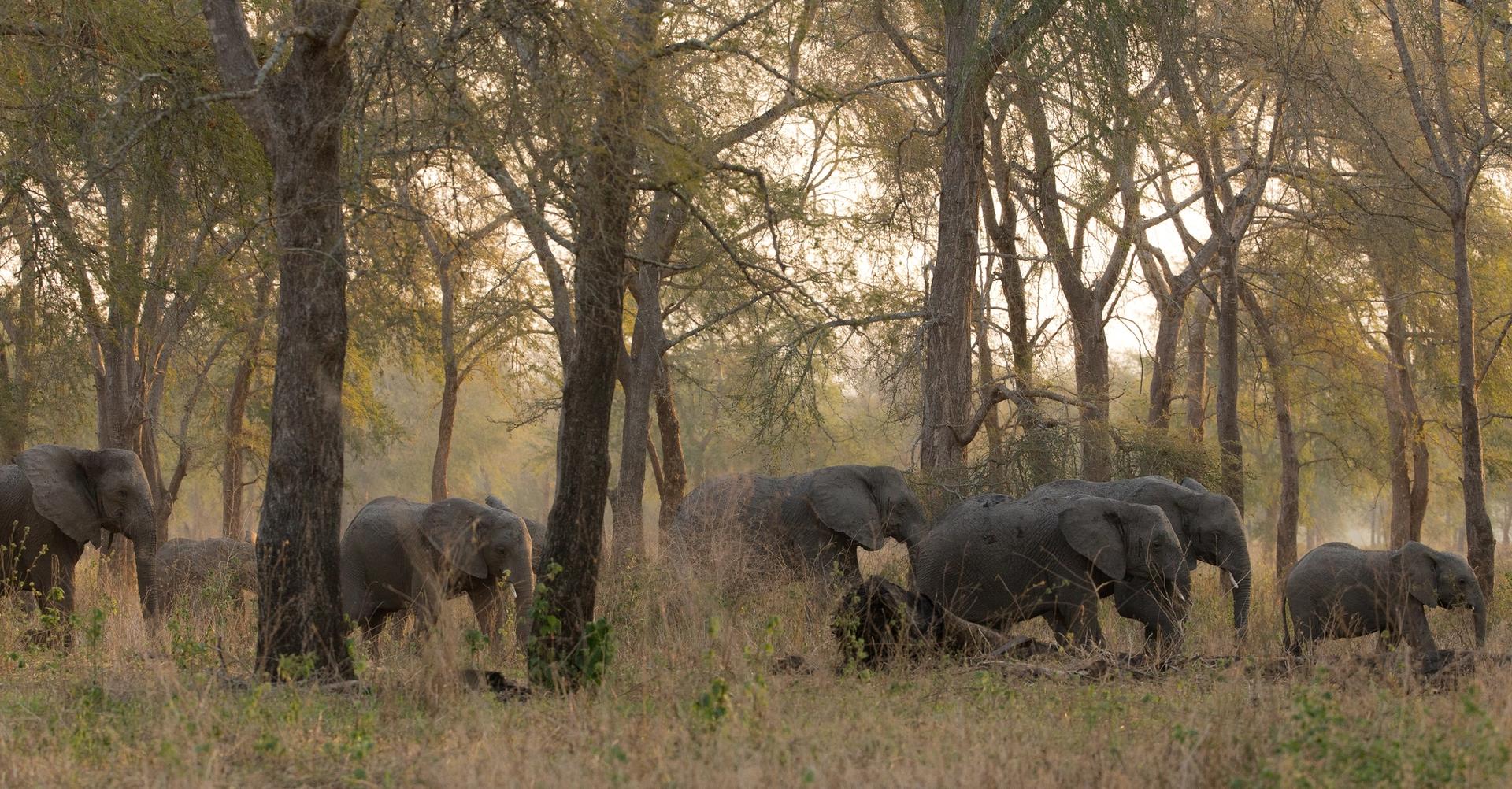
Since the origin of elephants, about 60 million years ago, the order Proboscidea has included at least 160 species in 39 genera, in an extraordinary array of forms. The African and Asian elephants existing today are the sole remnants of that spectacular radiation, and they, too, may be close to the end of their time on earth.
It was with decades of experience studying elephant communication and behavior and an equal number of years witnessing, firsthand, the suffering of elephants, that we envisioned something along the lines of a Bill of Rights for elephants.
It seemed that, no matter where we turned, there were issues related to the treatment of elephants. Management practices, poaching for ivory, capture of elephants for captivity, and the holding of elephants captive led us to ask:
How should we treat these extraordinarily complex, intelligent, social beings? What rights to exist or to be given fair treatment should they have in our anthropocentric world?
The Elephant Charter, written in 2007, was the result.
The purpose of The Elephant Charter is to provide a set of guiding Principles, based on elephant biology, to form a touchstone for anyone needing to address elephant interests. Buttressed by its Appendix, The Elephant Charter represents a consensus of the nature of elephants. It is intended to promote scientifically sound and ethical management and care of all elephants, providing guidance to law and policy makers, enforcement agencies and the courts, organizations, institutions and international bodies, as well as to managers of wild and captive elephants.
The Elephant Charter is independent of any particular group or institution. Rather, its force comes from the expertise and stature of the elephant biologists who are its signatories. Its authors, Joyce Poole, Cynthia Moss, Raman Sukumar, Andrea Turkalo and Katy Payne are eminent elephant field biologists who represent the longest studied populations of African savannah, Asian and African forest elephants: the elephants of Amboseli, Mudumalai and Dzanga Bai. With four decades of groundbreaking research on wild elephants, together with the research of our many colleagues, we are collectively in a position to speak with confidence about the interests of elephants wherever they may be.
The Elephant Charter resonates even more powerfully today than when it was written in 2007. Endorsed by Dr. Jane Goodall, Dr. Peter Singer, John Coetzee, Nick Brandt, Marc Bekoff, Paul Winter, Paolo Affonso and The Elephant Charter has been signed by well over 50 elephant biologists, more than 130 elephant professionals and over 1,400 friends of elephants. Please join us by signing The Elephant Charter and helping to change the way people think about our planet and all of its inhabitants.
"For thousands of years, people have praised and punished, elevated and degraded, revered and feared elephants. Now, the earth’s largest living land mammal is under threat, and with it a host of ecosystems. The destruction of elephants and their habitats has annihilated entire populations and pushed others close to the brink of extinction. Furthermore, the regular exploitation and abuse of individual elephants is a source of preventable suffering.
The preservation of elephants is vital to the health of the natural world and to the heritage of future generations; mistreatment of them is unworthy of our species. We, the undersigned scientists and conservationists, affirm that elephants are unique, important and irreplaceable. We, therefore, hereby introduce an Elephant Charter to promote the protection of all elephants from human conduct and institutions that cause their needless suffering or loss of life.
We recognise the right of people to go about their daily activities and economies without threat to life or livelihood from elephants. Nevertheless, when human endeavours threaten the future survival of elephants, people must examine their collective behaviour in relation to the needs of other species. We have reached such a time..."
The survival and well being of elephants is threatened by escalating poaching for the commercial trade in ivory and meat, the increasing loss and fragmentation of natural habitats, and by locally increasing conflict with humans over diminishing resources. These threats are fuelled by a growing market for ivory in Asia, by poverty and civil unrest, and exacerbated by misguided public policy.
Elephants as a species and as individuals have an intrinsic right to exist. We have an obligation to protect elephants and their habitats and to ensure their well being and continued survival in the face of human exploitation, encroachment and interference. If we wish elephants to survive we must bring a halt to the commercial trade in ivory and make major adjustments in public policies so to reduce conflict and promote peaceful coexistence.
Evidence Principle I. Conservation of Elephants
Rapidly expanding human populations, increasing levels of human consumption and the technologically enabled incursion of human activities into areas previously remote or uninhabited by people is causing the depletion and fragmentation of traditional elephant habitat, conflict and loss of life.
We must minimise the causes of conflict and promote the peaceful co-existence of people and elephants to ensure the survival of elephants and reduce suffering. Good governance in elephant range states is essential to success in this endeavor.
Evidence Principle II: Co-existence of People and Elephants
The perceived necessity for invasive elephant management practices such as the culling of populations and the shooting of 'problem' individuals is a consequence of increasing human demand for natural resources and shrinking elephant habitats. Commercial gain and human gratification motivate trophy hunting and the capture of elephants for human use. These practices are inhumane and have negative impacts on elephant society and behavior, and may exacerbate elephant aggression towards humans.
Elephants exhibit an interest in their own lives and empathy for those to whom they are attached; they have an intrinsic right to experience a life of well-being. Through human imagination and our scientific and creative abilities, we can and must curb our demand for the planet’s natural resources and, wherever possible, reduce our reliance on cruel and invasive elephant management practices.
Evidence Principle III: Management and Welfare of Elephants
All elephants, including those held captive, are wild animals, and share traits that have evolved over millions of years. For over four thousands years the welfare of captive elephants has been compromised through human ignorance, indifference and self-indulgence. In an ideal world elephants would not be held in captivity, but thousands are. Captive and confined elephants suffer from a host of physical and psychological conditions not observed in the wild. Good zoos and other welfare oriented captive environments are making strides to improve the living conditions of captive elephants.
Elephants have an intrinsic right to experience a life for which, through evolutionary time, they have been adapted. We must endeavor to ensure that the core interests of captive elephants are met such that they do not suffer as a consequence of our actions. We encourage all those working toward improving the lives of captive elephants.
Evidence Principle IV: Management and Welfare of Elephants Held Captive
Elephants are intelligent and vigorous creatures that have evolved in an extensive and complex physical and social environment. Adapted to vast areas, the continuous larger and smaller scale movements related to the search for food, water, companions and mates are essential for elephant well being.
Elephants require sustained biologically relevant activities for body and mind. We are obliged to account for this and the consequent necessity of large space for elephants in the wild and sufficient space in captivity.
Evidence Principle V: Need for Space
Elephants interact in dramatic and complex ways with whole landscapes and ecosystems. Confinement of elephants may have multifaceted environmental consequences for both elephants and the species with which they share their natural space. Equally, their removal from ecosystems can have multifaceted environmental consequences.
We have an obligation to maintain the integrity of ecosystems that elephants inhabit, and must take realistic account of the needs of elephants in the planning and management of protected areas and landscapes.
Evidence Principle VI: Ecosystem Integrity
Family members play a crucial socializing and bonding role in the birth and development of elephant calves. The presence of mother and family is essential for the survival and the normal, healthy development of elephant calves. Without these relationships elephants grow up socially incompetent and the lasting effects of trauma suffered by elephants may translate into a cycle of violence directed toward human beings and other unusual objects of aggression.
We harm elephants when through human intervention we break close social bonds; in particular our management practices must strive not to break the bonds between mothers and their offspring.
Evidence Principle IX: Family Ties
Elephants are extremely long-lived mammals; longevity, experience and reproductive success go hand in hand. Older matriarchs act as a repository of social and ecological knowledge, thereby influencing the reproductive success and survival of their family members, while older males are the primary breeders.
We damage the fabric of elephant society when we remove older individuals; our management of wild elephants must reflect the importance of older males and females in maintaining the integrity of elephant society.
Evidence Principle XII: The Value of Longevity
The largest video and audio library of elephant behaviors.