
Author: Joyce Poole
Updated 06.08.2026
In a recent chapter in a book about Pointing, Lucy Bates, Richard Byrne and Joyce Poole explore how elephants understand and produce pointing gestures. Their research challenges human-centred definitions of pointing, suggesting that elephants may use their remarkably dexterous trunks and snouts to direct attention. By considering the diverse bodies and behaviours of other species, we open the door to a richer understanding of animal communication and cognition.
For too long, scientists have defined pointing through a distinctly human lens: an outstretched arm, an extended index finger, a shared line of sight. But human beings themselves point with their lips, heads, faces and entire bodies. So why should we expect another species—built differently, sensing differently and navigating a very different world—to point exactly as we do?
The problem may not be whether elephants can point. The problem may be whether we are imaginative enough to recognize it when they do.
Elephants are compelling candidates for pointing. They are large-brained, intensely social animals who live in complex, fluid societies. They maintain long-term relationships, share information and depend upon accumulated knowledge to find water, avoid danger, choose companions and make collective decisions. They communicate through sound, scent, touch, posture and movement. They also possess an extraordinarily flexible and sensitive appendage: the trunk.
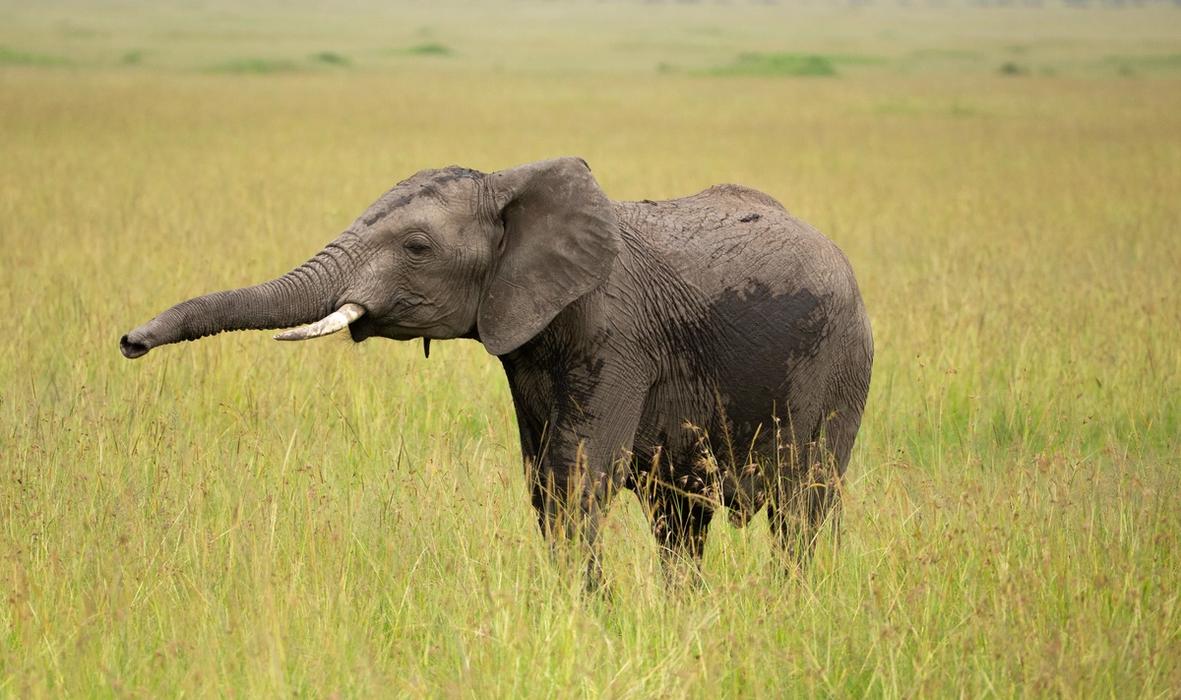
Elephants often appear to aim their trunks toward something of interest. Sometimes they extend the trunk horizontally; at other times they raise it in a distinctive S-shape known as a “periscope-trunk.” To a human observer, these actions can look remarkably like pointing.
But appearances can mislead. An elephant’s trunk is also its primary organ of smell. A raised or extended trunk may simply be sampling the air. A “point” could be a sniff.
Yet this does not make the gesture meaningless to others. Observations of wild savannah elephants suggest that when one elephant raises her trunk toward something, nearby elephants may orient their own trunks in the same direction—even when they are behind her and farther from the apparent source of interest. The first elephant may not intend to communicate at all, but her movement can still provide valuable directional information.
Does that count as pointing?
If we insist that pointing must be deliberate, then we need evidence that the elephant has a goal, checks whether others are paying attention and persists or changes tactics if they fail to respond. That evidence has not yet been established for the periscope-trunk. Scientific caution matters: we should not label every extended trunk a point simply because it resembles one.
But caution should not become a failure of imagination.
The trunk may not even be the elephant’s most intriguing way of pointing. Consider the “let’s-go-stance.” An elephant who wants to move may face in her preferred direction, rumble, swing a foot, begin walking and then wait. She repeatedly looks back to see whether others are following. Her entire body becomes a directional signal: This way. Are you coming?
Is that less of a point because no finger is involved?
Elephant mothers may tap a calf and swing the trunk before its eyes to direct its movement. Mothers with newborns have been observed repeatedly touching their own nipples, apparently guiding inexperienced calves toward milk. Trunk sweeps, foot swings and subtle shifts of the head, ears or body axis may all help direct another elephant’s attention or behavior.
Visit The Elephant Ethogram and search for the behaviors: Trunk-to-Infant-at-Breast; Trunk-Sweep, Periscope-Trunk, Body-Axis-Pointing or search for “pointing” in the captions.
Some elephants can also interpret human pointing. In experiments, captive savannah elephants used a person’s finger-point to locate hidden food—and could even generalize from a pointing hand to a pointing foot. Studies of Asian elephants have produced more mixed results, reminding us that species, individual experience, husbandry, motivation and experimental design all matter. An elephant’s failure to respond in a human-designed test may reveal as much about the test as it does about the elephant.
This is the larger challenge. Comparative cognition often asks animals to demonstrate intelligence on human terms, using human senses, human gestures and human definitions. Elephants experience a world rich in smell, low-frequency sound and seismic vibration. They can see behind themselves with only a slight movement and may feel through their feet that another elephant has begun to follow. If we look only for conspicuous visual signals, we may miss much of the conversation.
The real question, then, is not simply, “Do elephants point?”
It is: “What might pointing mean for an elephant?”
Perhaps elephant pointing is used to direct others toward danger, food, water or a desired route. Perhaps it is used to request action, share interest or teach a calf. Perhaps some gestures are intentional, while others merely reveal information that observant companions have learned to exploit. There may even be local traditions—different elephant communities developing different ways of directing one another’s attention.
We do not yet know. And that is precisely why the subject is so exciting.
If we define pointing by the shape of a human hand, we have already decided what we are willing to discover. But if we define it by what it achieves—directing another’s attention toward a place, object or event—we open an entirely different window onto animal minds.
Elephants may be pointing right in front of us. I think they are!
To learn more read our chapter in: Bates L, Byrne R, Poole J. 2026. Pointing with Your Nose: Do Elephants Point, and How Do We Know? In: Krause MA, Bard KA, Leavens DA, editors. Pointing: Culture, Development, and Evolution. Cambridge University Press. pp 356-371.

Three Stages of Maturity
While every male follows a similar developmental arc, each individual navigates his path in a unique way. Age, condition and social rank influence when a male comes into musth, how long it lasts and how he interacts with others. The stories of three Amboseli males — Esau, Pascal, and Craig — illustrate the spectrum of male life and strategy.
Elephantism
In 2002, Joyce Poole took Ryuichi Sakamoto out to watch elephants in the Maasai Mara. His visit to Africa inspired his album Elephantism. What is Elephantism?

New Study: Machine Learning Reveals That Elephant Choruses Encode Behavior and Show Vocal Convergence
When elephants rumble together, their overlapping voices are far from a jumble of sound. Our new study of the Amboseli elephants suggests that these choruses retain information about the social situation—and that, during some exchanges, individual voices become more acoustically similar. The findings offer a new window into how elephants communicate and coordinate their lives.

The largest video and audio library of elephant behaviors.