
For more than half a century, ElephantVoices has studied wild elephants to understand how they communicate and navigate their social world. We believe the best science comes from knowing elephants as individuals and following their lives across generations. This page explains why we do long-term fieldwork, how we identify and track elephants, and the tools we use - from observation and photography to acoustic recording and digital databases.
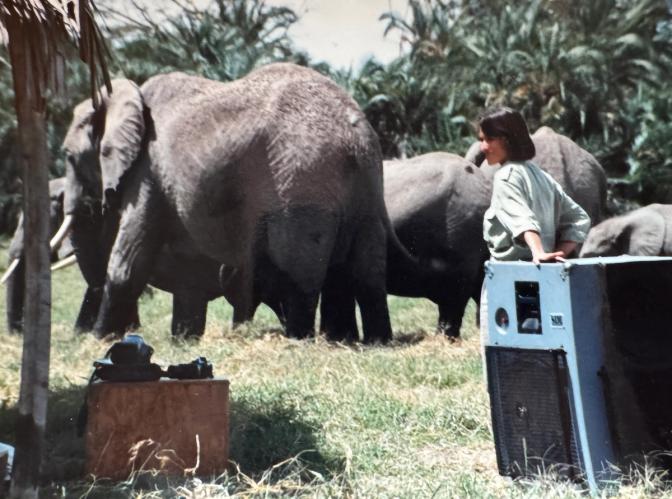
Outside her tent in the Amboseli Elephant Camp Joyce Poole leans against her 200 lb elephant playback speaker surrounded by the EB family
Carrying out field studies on elephants is part science, part keen observation, and part creative problem-solving. To truly understand beings whose lives are woven together across broad savanna landscapes by sounds we can’t fully hear, scents we can’t smell, and vibrations we can’t feel, we rely on a toolkit designed for watching, listening, and learning without getting in their way.
From pen and paper, iPhones, high-resolution cameras, long lenses, trail cameras, specialized audio recorders and mics to drones, film rigs, and powerful, 150 kg playback speakers to playback sounds to elephants, each piece of gear helps us capture behavior as it happens: subtle gestures, very low-frequency rumbles, family interactions, and the hidden patterns that shape elephant society.
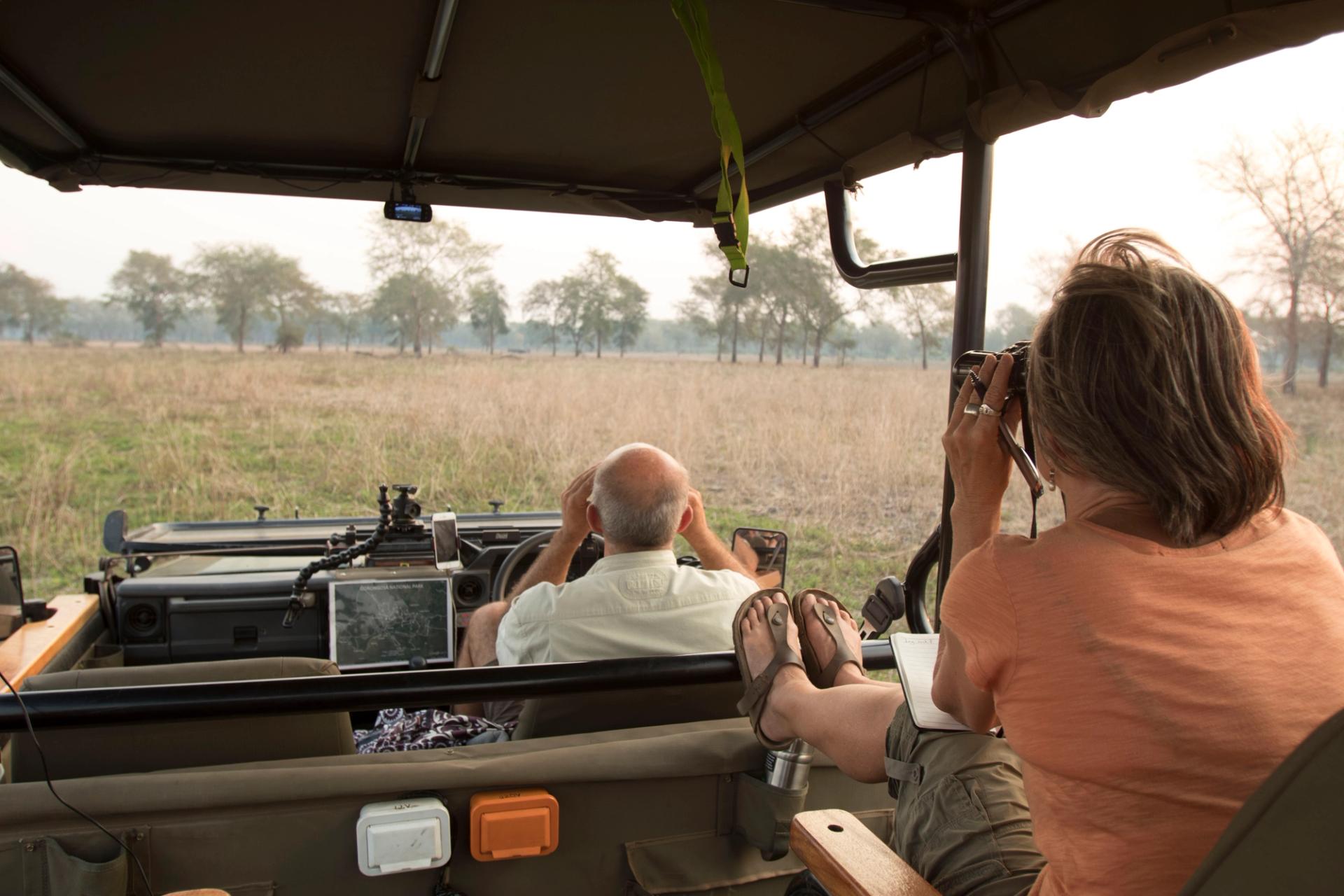
Studying free-ranging elephants depends on a good four-wheel drive all-terrain vehicle that is capable of following elephants most places they go without getting stuck. Your vehicle is your office, eight hours a day and often seven days a week. It should be trust-worthy and comfortable, despite hot, dusty and cramped.
Over the years we have studied elephants in a two-stroke Suzuki jeep, a Daihatsu Jeep, Land-Rovers, and short and long-wheel-base Toyota Land Cruisers. We have had had a soft spot for each and every of the field cars we have owned, but our open Land-Cruiser — custom-built for our field work in Gorongosa, Mozambique — was our all-time favourite.
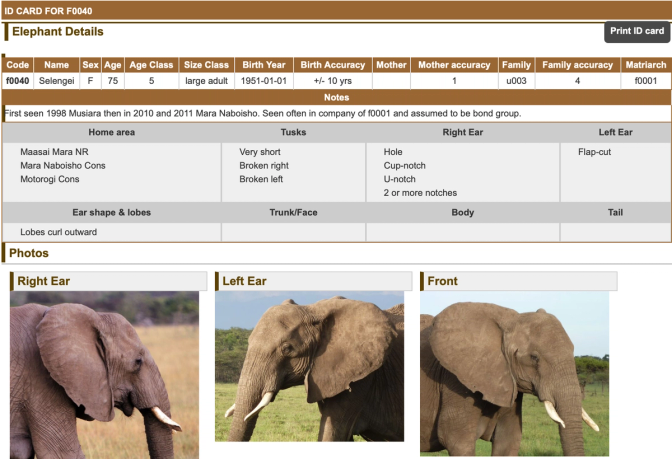
This is the matriarch, Selengei, from the Maasai Mara population
We identify and register elephants, documenting each with photographs, noting their physical characteristics, and collecting life history information. With each re-sighting we accumulate more knowledge on individuals, their families, and their social networks.
To understand a population, we must know who its members are — their sex, age, families, clans, and the habitats they depend on. Knowing who is who and who is related to whom helps us interpret how relationships shape behavior and communication.
In Amboseli we used physical photographic ID cards, while in Gorongosa and Maasai Mara we created digital ID cards and housed them in a database, known as the Who’s Who. We used a set of physical characteristics to search for individuals. You can learn how to ID elephants and read about the characteristics we used in the module, How to Identify African Elephants.
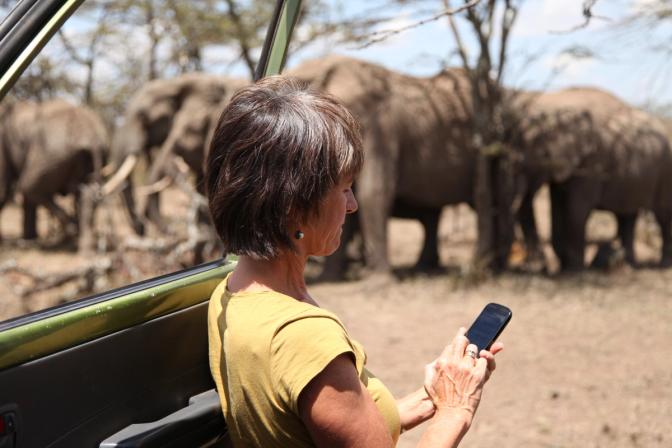
Each elephant individual or group that we observe is recorded as a “sighting.” Sightings include the date, time, location, number and identity of elephants present as well as our field notes. To collect and manage data more effectively, we developed an app, the EleApp, which allows us to record elephant observations via smartphone and upload them directly to our “Who’s Who & Whereabouts” databases. This system helps us to visualize population patterns and share critical insights with park management.
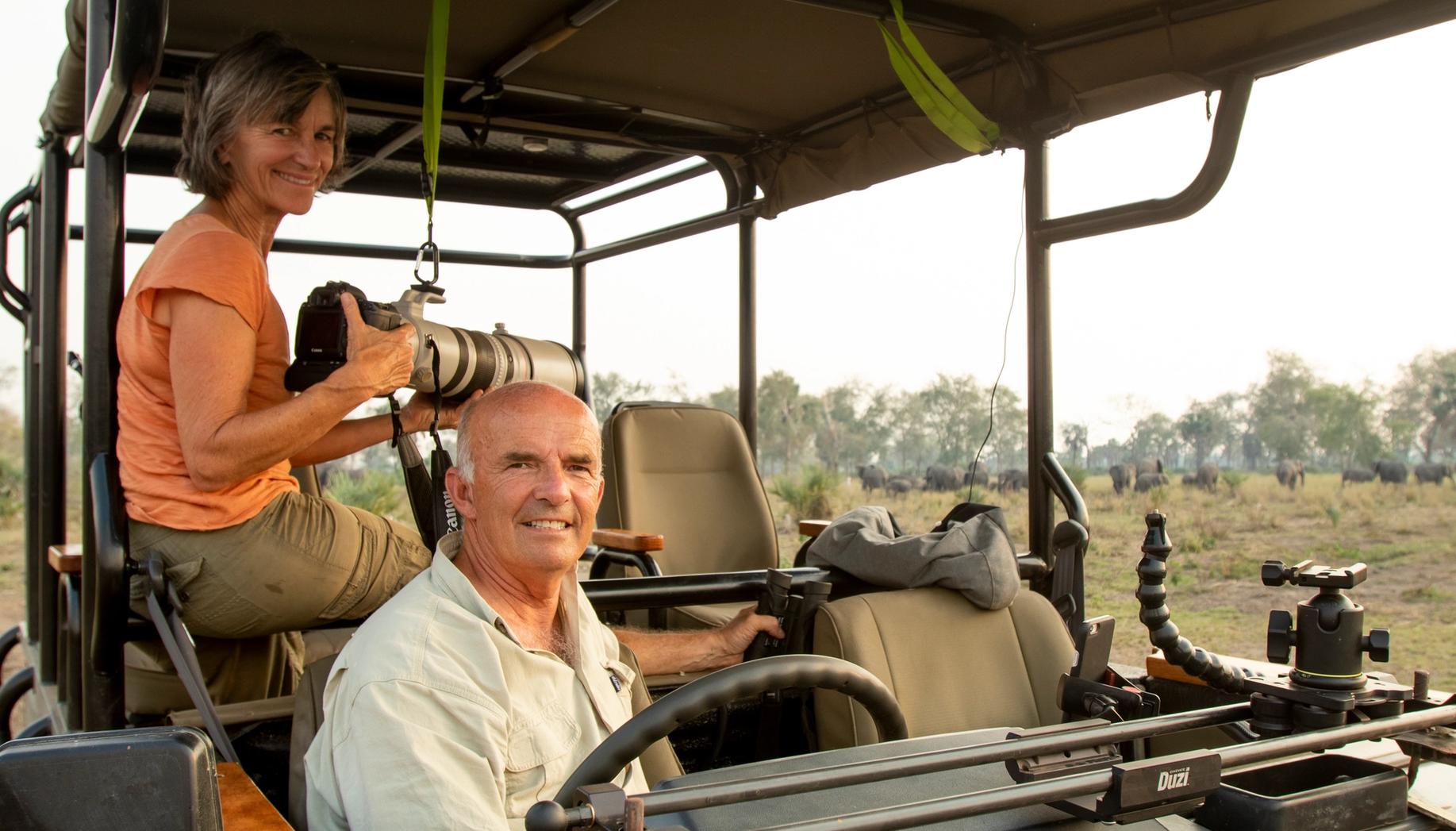
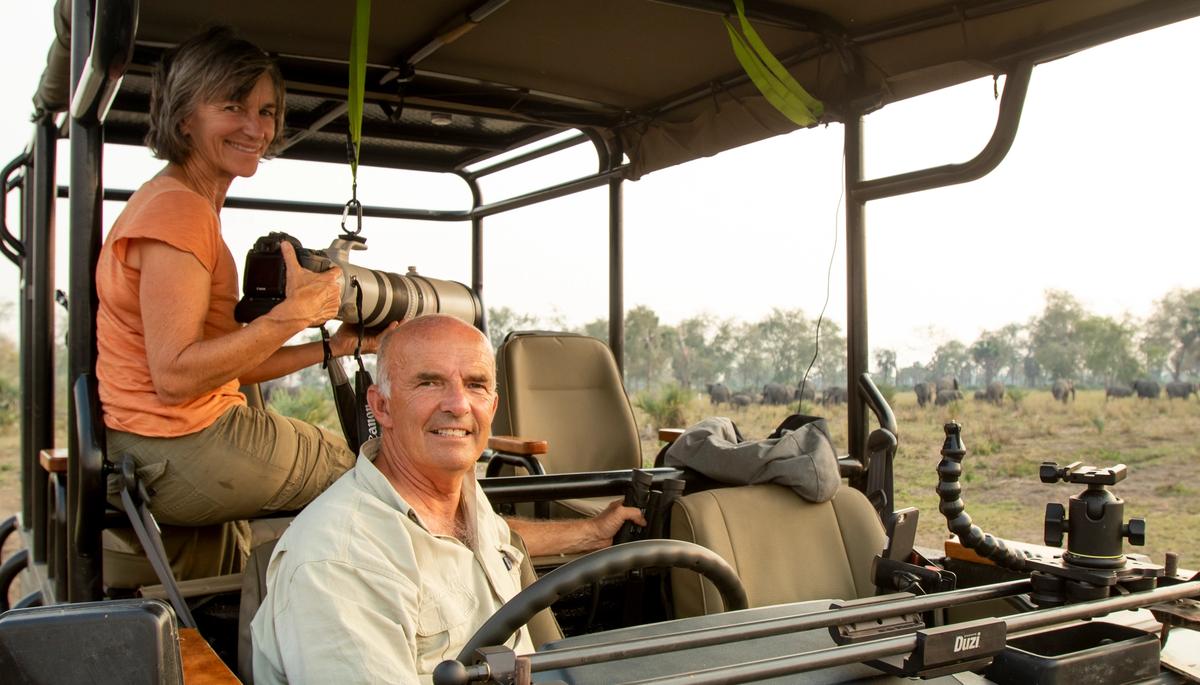
We use both still and video cameras to document individual elephants and their behavior. Images and footage form the basis for identification and for our long-term study of the behavioral repertoire of African elephants. The culmination of this work is The Elephant Ethogram: A Library of African Elephant Behavior, which catalogues the extraordinary diversity of elephant behavior and communication.
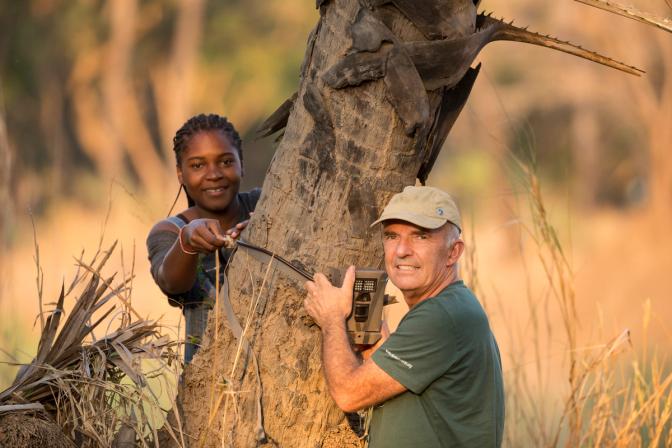
Petter Granli and Michelle Souza set up a trail camera in Goronogosa
In Gorongosa where many of the elephant families avoid roads and move away from vehicles, we documented the presence, structure and behavior of many families by setting up trail cameras. Read The Gorongosa elephants through war and recovery: tusklessness, population size, structure and reproductive parameters and Effects of human settlement and road on diel activity patterns of elephants (Loxodonta africana) to find out what we learned about the Gorongosa elephants from trail cameras.
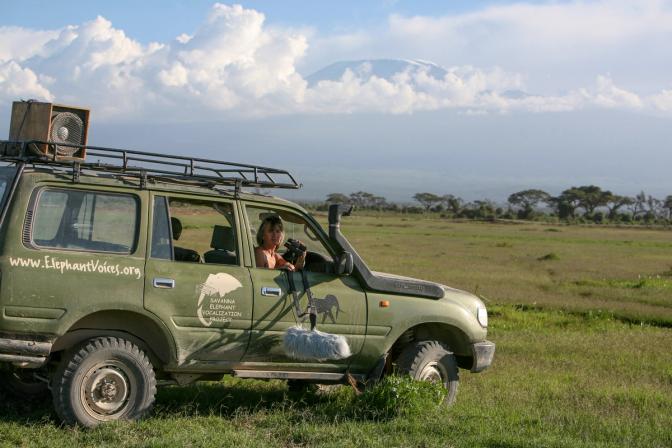
Since the mid-1980s, we have been recording the voices of elephants — capturing rumbles, trumpets, roars, and call combinations that form the basis of their communication. To accurately capture the very low frequency voices of elephants, we use specialized microphones and recorders capable of recording sound below the range of human hearing.
Each recording represents a moment in the lives of elephants — a mother calling her calf, a greeting between family members, a display of dominance, or a coordinated movement across the landscape. Over the decades we have built one of the world’s most comprehensive acoustic archives of elephant communication.
We take detailed field notes to accompany our recordings, noting who we heard calling and in what context. Collected over decades, these data are held in the ElephantVoices Elephant Calls Database and forming a basis for much of what we know today about elephant vocalizations. They have revealed that elephants have a complex and nuanced vocal repertoire, using sound to express emotion, maintain family bonds, coordinate movement over long distances, call each other by name and make a plan of action.
The largest video and audio library of elephant behaviors.