
- Ele phant = arch great
- Earth’s largest land mammal
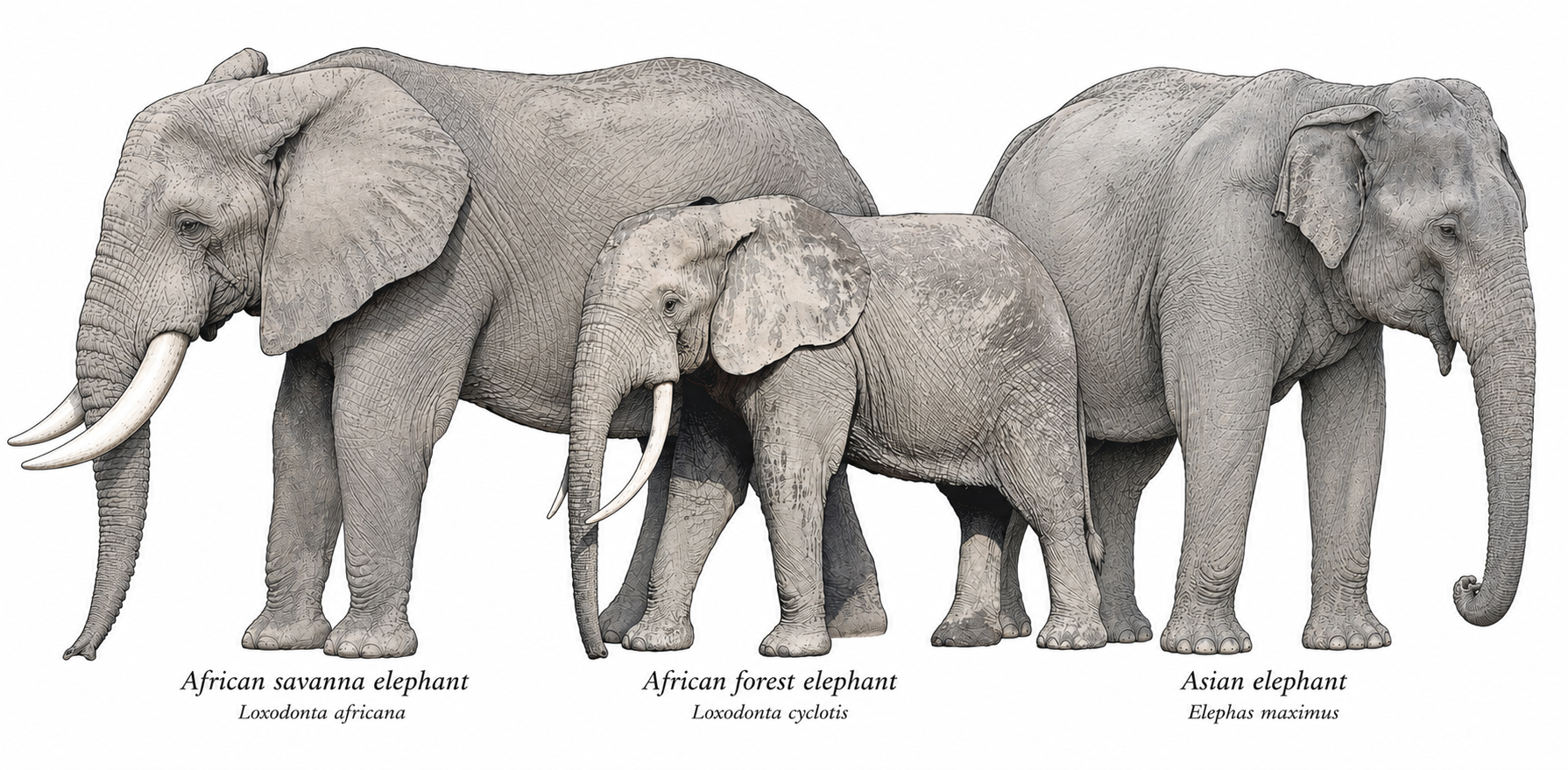
- Three species: African savanna, Loxodonta africana, African forest, Loxodonta cyclotis, Asian, Elephas maximus
- In 37 countries in Africa, 13 in Asia (2013). Once spanned continuous tracts across the continents, now live in increasingly fragmented areas
- Range across a wide variety of habitats from sea-level to 3,500 meters
- Daily food intake 4-7% of body weight
- Diet includes grass, herbs, tree foliage, fruit, bark, pith, lianas
- Trunk, a fusion of upper lip and elongated nose weighs up to 140 kg, can pick up a straw, push over a large tree, tenderly touch family members, pour 12 litres of water into its mouth, detect scents over several kilometres
- Tusks, composed of dentine, are elongated incisors; ivory has been coveted by humans for tens of thousands of years and has had lasting impact on art and culture
- Skin is up to 32 mm thick in places and almost paper thin in others
- Maximum life span approximately 70 years
- Age at first reproduction (females): 8-24 years
- Gestation: about 660 days
- Inter-birth interval: 4-6 years
- Females can give birth to up to 12 offspring
- Age at first musth (males): 15-28 years
- Basic social unit is the family, which includes a mother and her sexually immature offspring
- Live in complex fission-fusion societies, that separate and reunite based on weather conditions and food availability
- Families are led by matriarchs, who store decades of ecological knowledge that is critical for the survival of the family unit and members through droughts, predation and other threats
- Tend to have lifelong or long-lasting social bonds
- Brain weighs 4-6 kg, the largest of living and extinct terrestrial mammals
- Able to make and use simple tools, and show evidence of social learning
- Advanced acoustic, visual, chemical and tactile communication
- Able to communicate and maintain contact with other elephants over long distances using acoustic and seismic communication signals
- Able to discriminate between the voices of at least 100 other elephants
- Demonstrate socio-emotional complexities, such as empathy and self-recognition
- Display concern for distressed and dying elephants, not restricted to close kin
African savannaLoxodonta africana
African forestLoxodonta cyclotis
AsianElephas maximus
Population and status
Population 2024
Figures not updated
135,690 in surveyed areas
Figures not updated
Population 2016 (Estimates)
411,005
Included with Africa savanna
39,500–43,500 (wild)
Population 2007 (Estimates)
472,269
included with African savanna
~30,000 wild; 15,000 captive
Population 1979 (Estimates)
1.3 million both African species
Included with African savanna
28,000–42,000
IUCN Status
Endangered
Critically endangered
Endangered
Range states
37 countries in Sub-Saharan Africa
Native: Angola; Benin; Botswana; Burkina Faso; Cameroon; Central African Republic; Chad; Congo; Congo, The Democratic Republic of the; Côte d'Ivoire; Equatorial Guinea; Eritrea; Ethiopia; Gabon; Ghana; Guinea; Guinea-Bissau; Kenya; Liberia; Malawi; Mali; Mozambique; Namibia; Niger; Nigeria; Rwanda; Senegal; Sierra Leone; Somalia; South Africa; Sudan; Tanzania, United Republic of; Togo; Uganda; Zambia; Zimbabwe
Regionally extinct: Burundi; Gambia; Mauritania
Reintroduced: Swaziland
Found most commonly in countries with dense forests: Gabon, the Democratic Republic of Congo (DRC), Cameroon and Central African Republic in central Africa and Côte d'Ivoire, Liberia, and Ghana in West Africa
Native: Bangladesh, Bhutan, Cambodia, China, India, Indonesia (Kalimantan, Sumatera), Lao People's Democratic Republic, Malaysia (Peninsular Malaysia), Myanmar, Nepal, Sri Lanka, Thailand, Viet Nam
Regionally extinct: Pakistan
Physical measurements
Ave. max height male
Almost 4 m
2.4 m
Almost 3.5 m
Ave. max height female
Almost 2.7 m
1.98 m
2.4 m
Ave. max weight male
6,000 kg
–
5,500 kg
Ave. max weight female
2,767 kg
–
–
Ave. weight newborn
120 kg
–
90 kg
Ave. age at male independence
14 years
–
–
Body shape and characteristics
Back shape
Concave
Concave
Convex
Highest point
Shoulders
Shoulders
Head
Ears
Very large triangular
Typically smaller, more rounded
Smaller, triangular, prominent ear folds
Skin
Highly wrinkled and rough; deep creases allow their skin to retain moisture. Skin can be up to 2.5 cm in places.
Wrinkled skin though slightly smoother than African savanna elephants.
Smoother and thinner than either species of African elephant. Some individuals lack pigmentation on parts of their face, ears and trunk giving them pinkish-brown patches, which can be useful for individual identification.
Teeth
Lozenge-shaped loops
Lozenge-shaped loops
Narrow compressed loops
Mandible
Short and wide
Long and narrow
–
Trunk
Two finger-like tips
Two finger-like tips
One finger-like tip
Toenails
Four on forefoot; three on hindfoot
Five on forefoot; three on hindfoot
Five on forefeet, four on hind foot
Tusks and ivory
Tusks, male
Thicker, more curved than forest
More slender and straighter than savanna
Yes, but many are tuskless
Tusks, female
Thicker, more curved than forest
More slender and straighter than savanna
Vestigial or absent
Tusklessness
More common in females; % varies depending on ivory hunting pressure
% varies from population to population
Males: Varies from population to population
Tusks, average max weight
10-25 kg female; 23-45 kg male
5-12 kg female; 10-20 kg male (inferred from museum and field specimens)
females lack true tusks and there no scientific data available for males
Tusk, max. recorded weight
117 kg
~50–60 kg (estimated)
73 kg
Ivory
Softer and more yellow than forest
Harder and "pinker" than savanna
Creamy white
Behaviour and habitat
Family structure
Live in stable and matrilineal families typically composed of multiple adult females and their offspring and led by the eldest female, matriarch. Show complex social multi-tiered networks and maintain long-term kin-based relationships.
Form smaller and less cohesive social units typically consisting of a mother and her dependent offspring. As with the other two species, maintain long-term kin-based relationships, but display less integrated social structure due in part of ecological contraints of dense forest habitats.
Live in stable matrilineal family, but with more fluid fission-fusion associations than African savanna elephants. Maintain long-term kin-based relationships.
Independent males
Form all-male groups
Form all-male groups
Form all-male groups
Average home range
Up to 11,000 km² (desert elephants)
Up to 2,000 km²
Up to 4,000 km²
Temporal gland secretion
Both sexes; common in females
Both sexes; uncommon in females
Both sexes; very rare in females
Sound production
As low as 10 Hz
As low as 5 Hz
As low as 8 Hz
Predators
Humans; juveniles, calves: lions, hyenas
Humans
Humans, tigers
Major Threats
Illegal killing for ivory and meat. Trophy hunting. Loss and fragmentation of habitat due to expansion of human population and land development. Human-elephant conflict mainly due to habitat encroachment.
Illegal killing for ivory and habitat loss. Loss and fragmentation of habitat due to expansion of human population and land development. Human-elephant conflict mainly due to habitat encroachment.
Habitat loss, degradation, and fragmentation, leading to human-elephant conflict and death. Asian elephants live among the most dense human populations in the world. Poaching for meat, leather, and ivory.
Population and status
Population 2024Figures not updated
Population 2016 (Estimates)411,005
Population 2007 (Estimates)472,269
Population 1979 (Estimates)1.3 million both African species
IUCN StatusEndangered
Range states37 countries in Sub-Saharan Africa
Native: Angola; Benin; Botswana; Burkina Faso; Cameroon; Central African Republic; Chad; Congo; Congo, The Democratic Republic of the; Côte d'Ivoire; Equatorial Guinea; Eritrea; Ethiopia; Gabon; Ghana; Guinea; Guinea-Bissau; Kenya; Liberia; Malawi; Mali; Mozambique; Namibia; Niger; Nigeria; Rwanda; Senegal; Sierra Leone; Somalia; South Africa; Sudan; Tanzania, United Republic of; Togo; Uganda; Zambia; Zimbabwe
Regionally extinct: Burundi; Gambia; Mauritania
Reintroduced: Swaziland
Physical measurements
Ave. max height maleAlmost 4 m
Ave. max height femaleAlmost 2.7 m
Ave. max weight male6,000 kg
Ave. max weight female2,767 kg
Ave. weight newborn120 kg
Ave. age at male independence14 years
Body shape and characteristics
Back shapeConcave
Highest pointShoulders
EarsVery large triangular
SkinHighly wrinkled and rough; deep creases allow their skin to retain moisture. Skin can be up to 2.5 cm in places.
TeethLozenge-shaped loops
MandibleShort and wide
TrunkTwo finger-like tips
ToenailsFour on forefoot; three on hindfoot
Tusks and ivory
Tusks, maleThicker, more curved than forest
Tusks, femaleThicker, more curved than forest
TusklessnessMore common in females; % varies depending on ivory hunting pressure
Tusks, average max weight10-25 kg female; 23-45 kg male
Tusk, max. recorded weight117 kg
IvorySofter and more yellow than forest
Behaviour and habitat
Family structureLive in stable and matrilineal families typically composed of multiple adult females and their offspring and led by the eldest female, matriarch. Show complex social multi-tiered networks and maintain long-term kin-based relationships.
Independent malesForm all-male groups
Average home rangeUp to 11,000 km² (desert elephants)
Temporal gland secretionBoth sexes; common in females
Sound productionAs low as 10 Hz
PredatorsHumans; juveniles, calves: lions, hyenas
Major ThreatsIllegal killing for ivory and meat. Trophy hunting. Loss and fragmentation of habitat due to expansion of human population and land development. Human-elephant conflict mainly due to habitat encroachment.
The largest video and audio library of elephant behaviors.