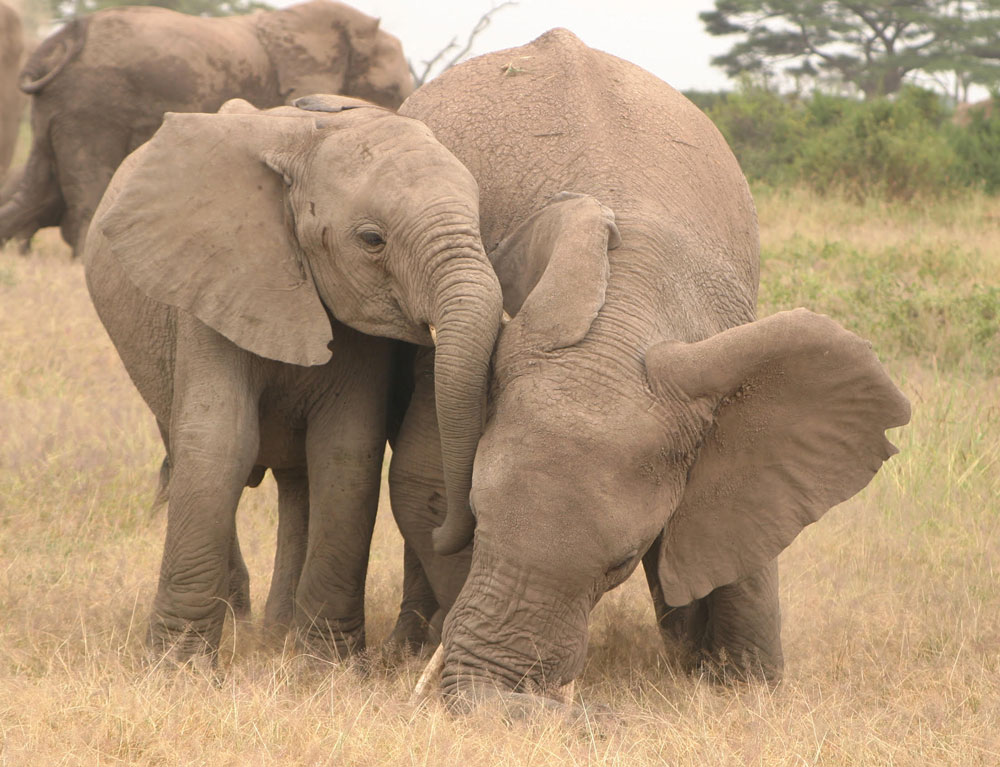

Wednesday, Thursday and Friday next week (1 to 3 September) we're attending the international symposium Compassionate Conservation, Animal Welfare in Conservation Practice, held at the University of Oxford. The symposium is arranged by The Wildlife Conservation Research Unit (WildCRU) and the Born Free Foundation, and includes more than 40 speakers representing a variety of perspectives on this important conservation topic.
Joyce is presenting our talk "Elephants on the edge: The use and abuse of individuals and societies". Presentations from the symposium will be posted on Compassionate Conservation' website, and we will also post a video version of ElephantVoices' presentation on ElephantVoices.org.
Abstract ElephantVoices' presentation:
The lives of individual animals matter, because what we do to them has consequences for their well being and for the health of the complex societies in which they live. The continued existence of populations of social species, like elephants, is dependent upon the endurance of friendships and the integrity of families and clans. In the name of conservation and "sustainable utilization" these individual building blocks of societies are often forgotten, purposefully ignored and disposed of as organizations and nations barter away lives to supply the ivory trade, provide for a hunter's bullet and supply captives for zoos, circuses and elephant-back safaris.
The sentiment that wildlife must "pay to stay" underlies a widespread attitude in which individual animals, societies and species have no business being here unless they prove themselves commercially useful. Yet, with this undermining of respect for other sentient beings, what will happen as human populations continue to soar and wild animals and their habitats inevitably dwindle? Instilling understanding of the interdependence of life, and accountability and compassion for the lives and interests of other beings, must be incorporated into our conservation philosophy to ensure the health of our planet, its web of species and our own survival.
On 3rd September Smithsonian's National Zoo in Washington DC is opening Elephant Trails (see video below). The zoo calls the elephants' new home "innovative" and "groundbreaking". From our perspective it shows very little understanding of the real interests and needs of elephants. Our friend and colleague, Peter Stroud, has written an Op-Ed for Washington Post, which was published today.
We have stolen the title to this page from Peter's excellent piece - "ill-fitting" describes the new Elephant Trails perfectly. It is disturbing that with $50 million of tax payers money spent on this new exhibit the Smithsonian's National Zoo was not able to do better. In memory of Toni (photo), and with all that could have been done for the National Zoo's elephants at Front Royal or at one of the elephant sanctuaries, we hoped for much more.
If we go back five and a half years: In early January 2005 we visited National Zoo, partly to see 40-year-old, Toni, who we had been told was in very bad condition. We watched Toni for a few hours from outside her barren enclosure - it was obvious that she was in pain with severe arthritis. Afterward, we met with National Zoo Director, John Berry, hoping that we could persuade him to send Toni to an elephant sanctuary, where she would have more space and freedom. We told him straight out that we predicted that Toni would die if they didn't do something urgently to improve her situation. Berry told us that Toni was fine, and that she had looked like that for decades.
On 11th January 2005 we sent a letter to the Zoo (374.34 kB), arguing for what we believed would be the best for Toni and the Zoo; we never received an answer. On 25th January, three weeks after our visit, Toni was euthanized. Toni is a grim example of what a life in captivity leads to. Her death triggered this article in the Washington Post.
The National Zoo is calling Elephant Trails "the cornerstone of our campaign to save Asian elephants." We are dumbfounded. How is keeping a few elephants in an inadequate space in North America "saving the Asian elephant"? To state that this new enclosure is the Zoo's "cornerstone" to save Asian elephants undermines the good science and education efforts that the Smithsonian Institution is doing for elephants. And that is a pity.
As tourists we often don't consider what goes on behind the scenes when entertainment and "local culture" involve animals. One can easily be charmed by the experience of elephant-back safaris and rides, elephant football or elephant polo, not knowing the brutal reality that is often behind these kind of activities. The use of elephants in tourism has become an industry in itself, which you can read more about on this page.
Shubhobroto Ghosh has written a read-worthy article about elephant polo in Monsoon 2010 - Elephant polo: conservation activity or animal abuse? (1.3 MB). The article touches on the involvement of a high profile Asian elephant conservation group, Elephant Family, who should know better. We advise you to read the article, post this page on your Facebook account (click on SharePage, FB option, in top right corner) or forward the URL to this page to friends. If you are a supporter of Elephant Family you may want to
This e-mail address is being protected from spambots. You need JavaScript enabled to view it
you disagree with their support of this "sport."
The video below - "The Performance" - is one of the most powerful ones about performing animals we have seen - and even though it is sad and disturbing it should be spread far and wide. Many of your friends might not know about all the cruelty that animals in entertainment experience. The video is focused on China - but most of the scenes could, unfortunately, have been filmed anywhere.
What the video shows about elephants is one reason why we dedicate so much of our time to improving the welfare of these amazing, intelligent creatures. Your support for our work and the work of organisations such as Animals Asia Foundation can make a difference. Elephants and other animals deserve to be treated with dignity and respect. Help us to change the way animals are treated. Visit http://causes.com/elephantvoices on Facebook or our Donate Now page on ElephantVoices. Read more about elephants in captivity here.
The review team assessing the attack by Toledo Zoo's (Ohio, US) seven year old African elephant, Louie, on his keeper July 1 does not even try to explain why this might have happened, other than to say that Mr. RedFox first entered the enclosure without a bullhook. (Toledo Zoo press release) It took this unfortunate incident to get the zoo to begin caring for Louie using protected contact.
The relationship between Mr. RedFox and Louie was not one of friendship, as the Zoo tried to argue, but one of a man trying to exert his will over that of a much larger elephant. Dominance among wild elephants is based on body size; people try to "pull rank" and to maintain control over their much larger charges by using a bullhook for backup. In our opinion that is just asking for trouble.
Elephants have incredible memories - the wiring of their brains suggest even better than our own - and they are very good at keeping score. Louie exhibited a lot of aggression toward Mr. RedFox as is documented in our letter (106 kB) sent to Toledo Zoo's Executive Director, Dr. Anne Baker. You will find an introduction to the letter, and the video showing the attack, here.
No way! - I completely desagree with this pract...
artist visual - I put my voice for dignity of a...
Mrs - Keep up the good work, how tragic that th...
Cover Up - This is the sentence I find so unbel...
Thank you for the clearly researched, scientifi...
Stop Ignoring Scientific Facts! - Thank you, Dr...
Poor Louis! - Thank your Joyce for describing i...
A good step, thank you - Hello Joyce and Petter...
Thank you, Dr Poole, for your vital input. Eac...
So Sad ... But So True! - As long as Mr. RedFox...