
| Elephants are long-lived |
|
|
|
Elephants are slow-growing, long-lived mammals, surviving up to 70 years These older and more experienced individuals are often targets of ivory poachers and sport hunters because of their generally larger tusks, but their removal can have serious consequences. Elephants rely on older members for their social and ecological knowledge and leadership abilities, and entire families and even populations may be damaged by the removal of a few key individuals. Elephant calves mature slowlyAn elephant pregnancy lasts about 660 days, or approximately 22 months. Once an elephant is born it matures slowly and is dependent on its mother's milk for more than two years. In Amboseli, calves rely solely on their mothers to meet their energetic requirements for survival and growth during the first three months of life. After that they begin to feed independently, but they do not achieve substantial levels of food intake until they are at least two years old. By age three, calves can be fully weaned although they typically suckle for longer.Elephant calves are also dependent on their mothers and other family members for protection, socialization and comfort. Mothers and allomothers (adolescent females who participate in the care of infants) take care of calves. Communal suckling (suckling from individuals other than the mother) is often observed, and although it is usually comfort suckling involving non-lactating, adolescent females, it is not uncommon to observe grandmothers allowing the calf of a young daughter to suckle. The vast majority of nutritive suckling, however, tends to be restricted to mothers.
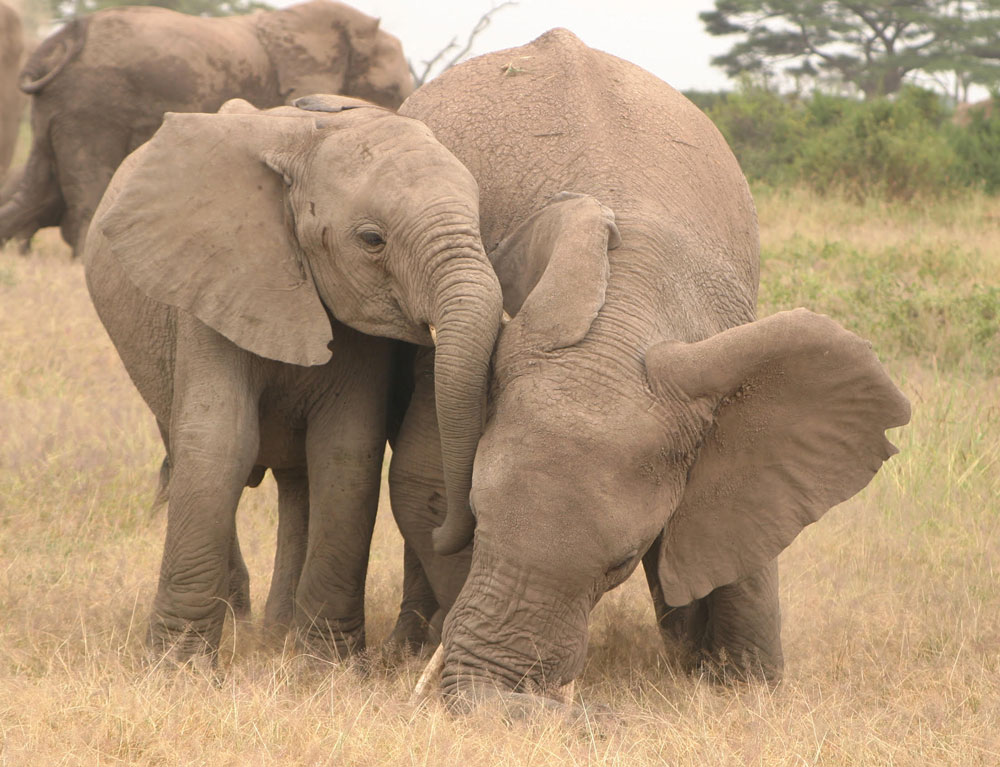
Allomothers are very important to the care and development of calves. Calf interactions such as greeting, comforting, rubbing or dusting and food testing takes place most often in the company of juvenile and adolescent allomothers. Calves stay in very close proximity to other members of their family. Under eight years old calves spend 80% of their time within five meters of their mother and 91% of their time within five meters of another adult family member. In fact, immature elephants spend more than half of their time a meter or less from another family member. Calves benefit enormously from the presence of these extra care-givers. The more allomothers in an elephant family the better chance a calf has to survive. Elephants seem to understand a mother's relative calf rearing experience because calves born to inexperienced mothers tend to receive more care from allomothers than calves of experienced mothers. Age affects female reproductive successElephants mature slowly, and have a long reproductive lifetime. Female elephants give birth to single calves (although twins have been recorded) at approximately four to five-year intervals and have been documented with up to 12 offspring per lifetime, though this number is rare. The age of first birth varies across populations and from individual to individual, ranging from as young as 7 to as old as 22 years. Most females give birth for the first time between 14 and 15 years old in African elephants, and slightly later for Asian elephants. Fecundity is fairly constant between the ages of 16 and 40 and then declines slightly, though females over 60 can still give birth. Most females in the Amboseli population have given birth to their first offspring by the age of 15 and the majority of 50 year-old females in the Amboseli population still reproduce and there have been several births to females over 60 years old. Despite their long reproductive life, each female produces relatively few offspring in her lifetime. Although females as young as 7-10 years may give birth, calves born to these very young mothers have a significantly lower chance of surviving their first year than calves born to older mother. Younger mothers are less experienced in calf care, and they are themselves still growing. Female elephants grow in height and weight well into adult life, growing quickly during the first ten years of life and then slowing to between one and two centimeters in height per year. Although growth in height has slowed by the age of a female's first calf there is still potential for a female to gain an additional 50-70 cm in height. Young mothers have to trade-off reproductive effort with their own growth; if they reproduce early they divert resources away from growth and may not be able to provide their infants with as much nourishment as older females. Older females act as a repository of social knowledgeThroughout an elephant’s life, environmental fluctuations and a changing social world require constant behavioral adaptation. The acquisition and retention of knowledge throughout life appears to be essential to an individual’s survival and successful reproduction and to the development of elephant social complexity and communication. Longevity also provides an enabling environment for the development of strong bonds between individuals in a family.
Elephants appear to comprehend the better judgment of older females; calves of young mothers spend significant time in the close company of their grandmothers, family members run to the oldest individual in times of real danger, and groups led by young matriarchs seek out families with older leaders with whom to associate. A long lifespan and slow maturation are correlated with, and a necessary precondition for the development of both social complexity and large brain size. With large, complex brains and good memory, learned experiences and social complexity multiply during the long lives of individual elephants. Old females, with greater ecological and social knowledge, undertake different social roles than their younger relatives. The learning that supports transmission of cultural traditions occurs in the context of over-lapping generations that spend much of their time in close proximity. Male independenceBetween the ages of five to fifteen years, male and female elephants are distinguished by their physical maturation as well as the type of play, associations, and explorations they engage in. Males start to exhibit the beginnings of independence at around eight to nine years of age when they may spend a day or two away from their family. From then on young males steadily spend more time away from the family gradually moving towards self-reliance. During the pubescent years, a young male typically stays on the fringes of his natal group, often wandering off to find play partners from other families. Through these playful interactions, a young male learns the size and strength of his age-mates. Young males also show interest in the activities of older males and may be seen observing and sometimes even following their actions. This education and early socialization helps a male to avoid aggressive and possibly fatal encounters in the future. A young male's growing interest for novel male rough-housing partners from other families appears to be a trigger for his departure from his natal family. As a male grows he spends less and less time with his family. A male is considered independent when he spends less than 20 percent of his time with his natal family. The average age of independence in the Amboseli population is 14 years old, but there is a wide range, with some males leaving as early as nine and others as late as 18 years old. Male sexual maturityAn evolutionary reason for the males' departure from their family may be to avoid inbreeding and genetic research has shown that males do avoid breeding with close maternal and even paternal female relatives.
Male elephants grow rapidly during their teen years and continue growing, though more slowly, through most of their adult lives. Since males continue to grow in height and weight throughout their lives, older males are larger and generally dominant to younger males. Male-male competition and musthWhen a male is in his late teens or early twenties he typically comes into into musth for the first time. Musth, a period of heightened sexual activity and aggression is defined by unique behavioral displays, swollen and secreting temporal glands, dribbling strong smelling urine and a characteristic low frequency vocalization, the musth rumble. During musth, males also have increased levels of circulating testosterone. Musth males in the Amboseli population range from 17 to 63 years old.
There is a strong relationship between a male's age and his duration of musth. The musth periods of the young males may last only a matter of days. Males between 26-35 years old come into musth for slightly longer periods of time, usually for a couple of weeks in a row, and they also may come into musth several times in a longer sexually active period. But, by the time a male reaches 35 years old his sexual cycle becomes more distinct and by 40 years of age a male exhibits a well defined musth period of three to four months in duration in a predictable yearly cycle. The length of a male's musth period increases with age until he is approximately 50 years old when it starts to decrease. Length of life is the key to male reproductive successReproductive success is positively correlated with increasing age. Males attain peak reproduction between 40 and 55 years of age are still reproductively active at age 60, at that age siring as many calves as a 40-year-old male.
In addition, rank among non-musth males is determined by size and strength. A 15-year-old male weighs half that of a 40-year-old male. Large males frequently displace young males when they are competing for access to an estrous female and, if a young male is lucky enough to mount a female, he is most often forced down or knocked off! Males in musth rank above all non-musth males and, therefore, those in musth obtain more matings than non-musth males. Young males have to balance energy required for growth with the resources necessary to sustain musth periods. Old males have an advantage in that they are no longer growing as much as younger males and can therefore direct more energy to extended musth periods.Young males are out competed by older males, they have fewer and shorter periods of musth, and their musth periods are often during seasons with few females coming into estrous.
Males who do survive to old age become very high-ranking and, as older musth males, thay father many off-spring, passing on their genes to future generations. For example, Dionysus, was an Amboseli male who died at 63 years of age. He was unusual as he was one of the oldest males to escape the poaching epidemic of the early 1970’s. He was, therefore, one of the largest and highest ranking males in the population for almost 30 years. When Dionysus died in 2003 he was estimated to have fathered a minimum of 51 offspring (data as of 1997). Bad Bull was another male with high reproductive success due in part to longevity. He was last seen in musth in 2002 at the age of 63 and had fathered an estimated 62 offspring (data as of 1997). Aristotle was less fortunate. Though of the same age cohort as Bad Bull and Dionysus he died at 49 years old having fathered an estimated 27 offspring. The majority of males do not live long enough to father a single calf.
|
|||
| Last Updated on Sunday, 07 October 2012 11:52 |